Pylon Sign Foundation Engineering: A Complete Guide to Tall Sign Foundations
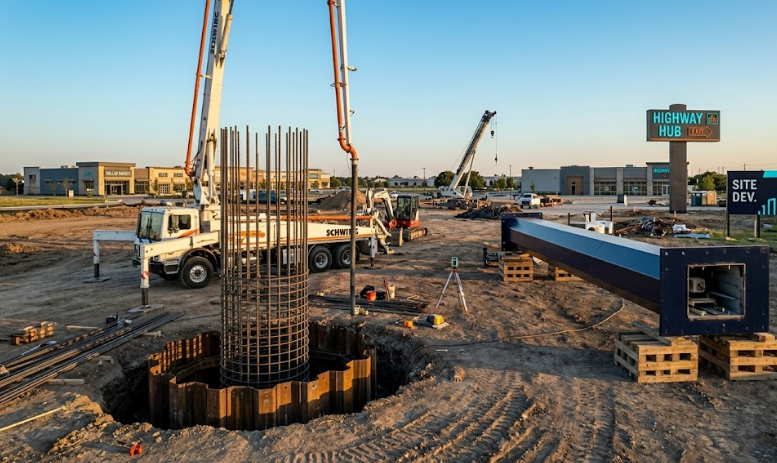
The visible part of a pylon sign is the cabinet, faces, and pole — the dramatic vertical structure that announces your business from highway distance. The invisible part is what keeps it standing: an engineered concrete foundation buried 6 to 20 feet underground, sized to resist wind loads that would tip an unsecured structure within seconds.
Foundation engineering is the single most technical aspect of pylon sign construction. Get it right and the sign stands for 30+ years through storms, seismic events, and decades of weather. Get it wrong and you have a public safety hazard, a code violation, and potential liability that dwarfs the cost of the sign itself. This guide walks through how pylon foundations actually get engineered, what drives the specifications, and why foundations are the longest and most expensive single phase of a pylon project.
Pylon signs require engineered concrete foundations sized by location-specific wind loads, soil bearing capacity, and seismic/hurricane zone requirements:
- Always required: Engineered foundation with engineer-sealed structural drawings
- 3 foundation types: Drilled pier (most common) · Spread footing · Mat foundation
- Typical depth: 6-15 feet (standard pylons), 15-30+ feet (highway billboards)
- Wind load drives design: 115-140 mph standard, 140-180 mph hurricane zones
- Hurricane zones cost more: 2-3x larger concrete volume than standard
- Timeline: 4 weeks end-to-end (excavation + pour + 14-28 day cure)
Why pylon signs need engineered foundations
Wall-mounted channel letter signs attach to the building with concealed studs. Box signs hang from cabinet brackets. Monument signs sit low and wide. None of these need underground foundations because the loads are modest and distributed across the building structure or a wide base.
Pylon signs are different. A pylon is a tall freestanding structure that acts as a cantilever in wind loading. The wind hits the sign cabinet at the top, the force gets multiplied by the height of the pylon, and the entire resulting moment gets transferred down through the pole to a single point at ground level. That point has to resist enormous overturning forces without the sign tipping, displacing, or failing.
An unsecured 30-foot pylon experiencing moderate 60 mph wind generates base moments measured in tens of thousands of foot-pounds. In hurricane conditions (140+ mph), those moments increase by a factor of 5 or more. The foundation is what transfers these forces safely into the ground. It is the most engineered component of any pylon sign project.
Get a geotechnical soil report before designing the sign. Soil bearing capacity directly drives foundation dimensions. Without knowing the soil, foundations get over-engineered (assuming worst-case soil and burning concrete unnecessarily) or risk under-engineering (which is much worse).
The three foundation types
Three primary foundation types cover almost every commercial pylon installation. The right choice depends on pylon height, soil conditions, site access, and engineering economics.
| Foundation Type | Best For | Typical Depth | Soil Requirements |
|---|---|---|---|
| Drilled pier | Most pylons up to 50ft | 6–15 feet | Standard bearing capacity |
| Spread footing | Shorter pylons, rocky soil | 4–6 feet | Hard substrate or rock |
| Mat foundation | Tall pylons, poor soil | 4–8 feet (wide) | Sandy/clay/poor bearing |
| Drilled pier (tall) | Pylons 35–50 feet | 12–20 feet | Standard bearing capacity |
| Caisson | Highway billboards, 50+ ft | 15–30+ feet | Special engineering required |
| Hurricane-zone drilled pier | FL HVHZ, Gulf Coast | 10–20 feet | Per soils + 140-180 mph wind |
Drilled pier (the most common)
A drilled pier is a deep cylindrical concrete foundation typically 3 to 6 feet wide and 6 to 15 feet deep. The pylon pole gets embedded directly into the pier, with rebar cage and anchor bolts engineered into the concrete pour. This is the standard solution for most commercial pylons in standard soil conditions and standard wind zones. It's the foundation type used on the vast majority of pylon installations across Houston, Dallas, Phoenix, and most US markets.
Spread footing
A spread footing is wider and shallower than a drilled pier — a reinforced concrete pad 8 to 12 feet wide and 4 to 6 feet deep. Used when soil is too hard to drill efficiently (rock substrates, hard caliche, weathered bedrock) or when site constraints prevent deep drilling. The wider footprint compensates for the shallower depth by distributing loads across more soil area.
Mat foundation
A mat foundation is a very wide reinforced concrete pad — sometimes 15 to 25 feet across — used in poor-bearing soils where neither drilled piers nor spread footings can safely transfer loads. Common in sandy coastal sites, soft clay, or filled ground. Mat foundations are expensive (high concrete volume, heavy reinforcement, large excavation) but sometimes the only viable option.
Caisson foundations (specialty)
For highway-scale digital billboards and very tall structures (50+ feet), caisson foundations extend 20 to 30 feet or more underground. These are engineered for the specific structure and site, often with steel casings, special concrete mixes, and extensive geotechnical investigation. Caissons are uncommon in standard commercial signage but standard for billboard structures.
Wind load: the primary engineering driver
The single largest engineering input for pylon foundation design is wind load. Engineers calculate the wind force the sign will experience based on four factors.
1. Design wind speed
Determined by local building code and ASCE 7. Most US markets use 115 to 130 mph as design wind speed. Hurricane-prone coastal zones use 140 to 180 mph. Inland Texas, the Midwest, and most of the West use 115 mph. Mountain regions sometimes use higher values for wind exposure factors.
2. Projected area of the sign
The wind acts on the visible face of the sign cabinet, multiplied by the wind pressure. A larger sign cabinet experiences proportionally larger wind forces. Double-face signs experience wind on both faces simultaneously (worst case is wind perpendicular to one face).
3. Height factor
Wind speed increases with height above ground. A pylon at 30 feet experiences higher wind than the same sign at 15 feet because the wind is faster aloft. This factor is built into building codes and amplifies the load on taller pylons.
4. Exposure category
Open terrain (highway frontage, agricultural land) gets higher wind loads than urban or suburban settings because there's less ground friction to slow the wind. Exposure category C (open terrain) is standard for highway pylons. Exposure category B (suburban) is used for interior commercial sites.
The resulting wind force gets translated into a base moment that the foundation must resist. The foundation is sized to provide that resistance with a factor of safety, typically 1.5 to 2.0 above the engineered load. This is why foundation dimensions increase rapidly with pylon height — doubling the height roughly quadruples the base moment, requiring meaningfully larger foundations.
Hurricane-zone foundations (Florida HVHZ, Gulf Coast, Atlantic corridor) are typically 2 to 3 times larger in concrete volume than standard-zone foundations for the same pylon. The 140-180 mph design wind speed roughly doubles the design load compared to inland 115 mph zones.
Hurricane zone requirements
Florida's High-Velocity Hurricane Zone (HVHZ — Miami-Dade and Broward counties) has some of the most stringent commercial sign engineering requirements in the United States. Pylon foundations in HVHZ are designed for 180 mph wind speeds, use heavier reinforcement steel, and require specialized engineer review beyond standard structural drawings.
Outside Florida, hurricane-prone markets (Gulf Coast, Atlantic coastal corridor, Carolina coast) use design wind speeds of 140 to 170 mph depending on specific location. The American Society of Civil Engineers (ASCE 7) wind speed maps drive these specifications, updated periodically based on hurricane research.
For Miami pylon installations specifically: count on 4-6 week permit timelines, specialized HVHZ engineering review, heavier concrete and reinforcement, and the longest installation lead times of any US market. The result is exceptionally robust signage that survives hurricanes the rest of the building may not.
Seismic zone considerations
Seismic engineering applies in California, Alaska, Hawaii, and parts of Nevada, Utah, Washington, Oregon, and the New Madrid fault zone (Missouri, Arkansas, Tennessee, Mississippi). High-seismic locations require additional foundation engineering:
- Heavier reinforcement steel in the foundation to provide ductility during seismic events
- Larger pier diameters in high-seismic zones
- Connection details between pole and foundation engineered for controlled flex
- Special inspection during foundation construction by certified seismic inspectors
Los Angeles, San Francisco, and San Jose pylon foundations cost meaningfully more than equivalent foundations in non-seismic markets due to these seismic enhancements. Plan timeline and budget accordingly when installing in seismic zones.
Soil testing and geotechnical reports
Most pylon sign installations require a geotechnical investigation before foundation design proceeds. The geotechnical report establishes:
- Soil bearing capacity: How much load the soil can support per square foot at depth
- Soil composition: Sand, clay, silt, gravel, organic content
- Water table depth: Where groundwater sits relative to foundation depth
- Frost line depth: How deep foundations must extend to avoid frost heave damage
- Allowable lateral resistance: Critical for cantilever loading on pylons
- Soil aggressiveness: Whether soil chemistry will attack concrete or rebar over time
The geotechnical report enables the structural engineer to specify the right foundation type and dimensions for the specific site. Without it, foundations get over-engineered (assuming worst-case soil) or risk under-engineering. A geotechnical survey typically adds 1 to 2 weeks to the project timeline and is required by most municipalities for tall sign permits.
Foundation failures are rare but catastrophic when they happen. A 30-foot pylon that tips during a storm becomes a 30-foot projectile. Property damage and liability dwarf the cost of the original sign. This is why over-engineering is the industry norm and why engineer-sealed drawings are non-negotiable on every pylon project.
Foundation construction timeline
Foundation construction is the single longest phase of a pylon sign project. Here's the typical sequence.
Week 1: Excavation and rebar
The drilling crew arrives with auger equipment (for drilled piers) or excavation equipment (for spread footings or mats). The hole is drilled or dug to the engineered specifications. The rebar cage is assembled and lowered into place. Anchor bolts (for the pylon pole base plate connection) are positioned precisely per the engineered drawings. This phase typically takes 2 to 4 days depending on soil conditions and equipment access.
Week 2: Concrete pour and curing setup
Ready-mix concrete is delivered to the site and pumped or chuted into the foundation. The pour is monitored for proper consolidation and vibration. Concrete test cylinders are taken for strength verification. After the pour, the foundation is allowed to cure undisturbed. Initial set occurs within hours; the foundation is touchable within a day; it reaches a fraction of design strength within a few days.
Weeks 3-4: Full concrete cure
Standard concrete reaches its design strength at 28 days of curing. Most foundation specifications allow sign installation at 14 to 21 days of curing (typically 75-85% of design strength), but full design strength at 28 days is the standard. Sign installation cannot proceed until the foundation has reached the specified strength threshold confirmed by test cylinder break tests.
After foundation cure: pole installation
With the foundation cured, the pylon pole is craned into position and bolted to the foundation's anchor bolts. The pole is plumbed, leveled, and secured. Sign cabinet installation follows. The entire installation from foundation pour to operational sign typically takes 5-8 weeks from start of construction.
Foundation work happens in parallel with cabinet fabrication. While the foundation cures over 3-4 weeks, the sign cabinet is being fabricated at the manufacturing facility. By the time the foundation is ready, the cabinet is ready to install. This parallel approach keeps project timelines manageable. See our permit timelines guide for the upstream permitting schedule.
Why foundation failures happen
True foundation failure (a pylon tipping or displacing under wind load) is rare in professionally engineered installations. When failures do occur, they usually trace to one or more of these causes.
1. Under-engineered for actual wind exposure
Foundation was designed for code minimum wind speeds but site experiences higher actual exposure (open coastal terrain, accelerated wind through building gaps, elevation-related wind amplification). Solution: site-specific wind analysis, not just code minimum.
2. Soil conditions different from assumed
Foundation designed based on assumed soil conditions, but actual soil at depth is weaker than assumed. Without a geotechnical report, this risk is real. Solution: always run soil testing for pylons over 15 feet.
3. Construction defects
Insufficient concrete consolidation, displaced rebar cages, low-strength concrete delivered, anchor bolts positioned incorrectly. Solution: certified concrete contractors, third-party inspection on high-risk installations, test cylinder verification.
4. Vehicle impact damage
Vehicle strikes the pylon, damaging the pole-to-foundation connection. Sometimes invisible from the surface. Solution: post-impact inspection of any pylon that's been struck, even if visibly intact.
5. Deferred maintenance
Anchor bolts corrode over time, especially in coastal or de-icing salt environments. Connections loosen. Solution: scheduled inspections every 5-10 years on pylon foundations. See our sign repair and maintenance service for inspection programs.
The bottom line
Pylon sign foundations aren't an optional detail or a place to save money. They're the engineered structure that keeps a multi-thousand-pound sign standing through 30 years of weather, including storms and seismic events. The engineering investment up-front prevents the catastrophic failure later that would dwarf the original cost.
The right pylon installation includes: geotechnical soil testing, site-specific wind load engineering, engineer-sealed structural drawings, certified concrete construction, third-party inspection on high-risk installations, and a foundation sized correctly for the specific location and conditions. The cost premium over a marginal installation is modest. The risk reduction is enormous.
For property owners and brand managers planning pylon installations: build realistic timelines into your project schedule (4-week foundation phase is non-negotiable for cure time), budget for geotechnical investigation, work with contractors who provide engineer-sealed drawings as standard, and treat the foundation as the project's most important structural component — because it is.
Foundation engineering for every wind zone in the US
Engineer-sealed structural drawings, geotechnical coordination, hurricane-zone HVHZ compliance, seismic-zone detailing, and certified concrete construction — included in every pylon sign project. Request a consultation for your specific site.
Frequently Asked Questions
Why do pylon signs need engineered foundations?
What types of pylon sign foundations exist?
How deep are pylon sign foundations?
How long does pylon sign foundation construction take?
What is wind load engineering for pylon signs?
Do pylon signs need different foundations in hurricane zones?
Do earthquake zones require different foundations?
What soil testing is required for pylon sign foundations?
What factors affect pylon sign foundation cost?
Can pylon foundations be reused for new signs?
American LED Signage is part of a network of commercial lighting and signage specialists with experience in structural engineering across all US markets. For projects beyond signage, see our partner sites: Dallas commercial LED, Fort Worth LED lighting, Arlington LED specialists, Plano commercial LED, Irving LED installations, statewide Texas LED lighting, wholesale LED components, American Starlight Ceilings for premium interior fiber optic ceilings, fiber optic lighting systems, modular building solutions, and modular structures in Dallas.