Channel Letter Signs vs Box Signs: Which Is Right For Your Business?
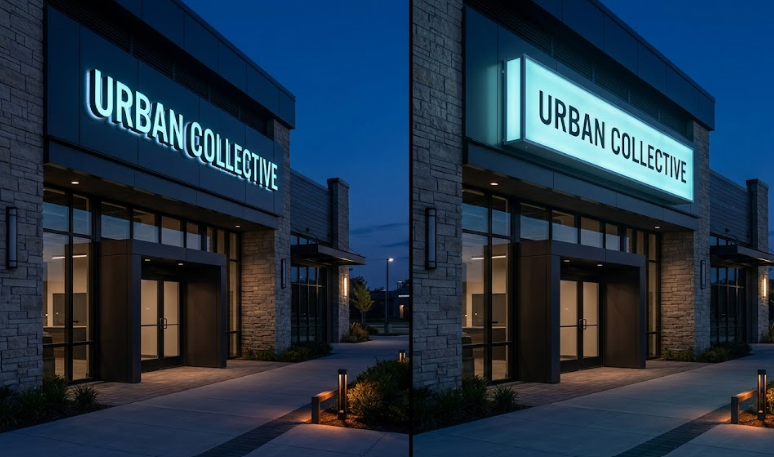
If you're getting your first commercial storefront sign — or replacing one that's seen better days — you'll face a fork in the road early on. The two most common formats for storefront identification are channel letter signs and lighted box signs. Both light up. Both display your business name. Both get the job done. But the differences shape your storefront's appearance, your budget, your maintenance schedule, and how your brand reads to anyone walking past.
This guide walks through what each format actually is, where each one fits, and how to decide which is right for your specific business.
Channel letter signs are 3D individually-fabricated letters that mount to your facade. Box signs are single illuminated cabinets with your branding displayed on one face. Key differences:
- Construction: Channel letters are dimensional · Box signs are flat illuminated cabinets
- Appearance: Channel letters look premium & architectural · Box signs look traditional
- Relative cost: Box signs cost 40-60% less than channel letters of equivalent size
- Lifespan: Channel letters 15-20 years · Box signs 10-15 years
- Permits: Both require sign permits + electrical permits
- Best for: Channel letters → premium retail · Box signs → strip mall & small business
What is a channel letter sign?
A channel letter sign is built from individually-fabricated three-dimensional letters. Each letter is its own little structure — a metal back, aluminum side walls (called "returns"), an illuminated face, and trim caps connecting the face to the returns. Inside each letter, LED modules provide the illumination. The letters mount directly to your building facade with concealed studs and a power raceway.
The hallmark of channel letters is dimensionality. Each letter sits proud of the wall by 3 to 8 inches. When illuminated, the letters glow individually — creating the "premium storefront" look you see on flagship retail, restaurants, and corporate buildings.
Four illumination styles available
- Front-lit: Translucent acrylic face glows. The most common style. Best for high-visibility commercial identification.
- Halo-lit (reverse-lit): Solid metal letter face with LEDs behind, creating a glowing silhouette on the wall. The premium aesthetic for upscale brands.
- Open-face: Exposed LED modules visible inside the letter return. Vintage aesthetic for entertainment venues and craft breweries.
- Combination: Mix of front-lit and halo-lit on the same sign for a layered effect.
Halo-lit channel letters cost 20-35% more than front-lit, but signal a premium brand position. Worth the upgrade for luxury retail, fine dining, and corporate headquarters.
What is a lighted box sign?
A lighted box sign is a single rectangular cabinet that houses all your business branding on one illuminated face. The cabinet is typically aluminum, the face is translucent acrylic or polycarbonate with your business name and logo applied as vinyl graphics, and LED modules inside the cabinet light it evenly from behind.
Where channel letters are dimensional and read as individual glowing characters, a box sign is flat and reads as one illuminated rectangle. Same idea, different execution.
Three primary configurations
- Single-face wall mount: Flush against the building, visible only from straight on. Most cost-effective option.
- Double-face projecting: Cabinet extends perpendicular to the building with sign faces on both sides — readable from both walking directions.
- Pylon-top: Same cabinet design mounted on top of a pylon sign pole structure for highway-frontage businesses.
Side-by-side comparison
The two formats differ across nearly every dimension that matters in a sign-buying decision. Here is what separates them at a glance — the rest of this guide walks through each row in detail.
| Factor | Channel Letter Signs | Lighted Box Signs |
|---|---|---|
| Construction | 3D individually-fabricated letters | Single illuminated cabinet |
| Visual feel | Premium, architectural, contemporary | Traditional, functional, direct |
| Relative cost | Higher (baseline) | 40–60% less than channel letters |
| Typical lifespan | 15–20 years | 10–15 years |
| Maintenance access | Per-letter (slightly more labor) | Single cabinet (easier) |
| Installation time | Longer (each letter mounted separately) | Faster (one mounting operation) |
| Permits required | Sign + electrical (standard) | Sign + electrical (standard) |
| Best fit | Premium retail, fine dining, corporate | Strip mall, small business, QSR |
Why is there a meaningful cost gap? Channel letters require more fabrication labor (each letter is built individually), more material (each letter has its own returns, face, and LED set), more electrical (each letter is wired to a power supply), and more installation labor (each letter is mounted to the building). A box sign is one cabinet, one face graphic, one set of internal LEDs, one electrical connection, one mounting structure.
For a typical 18″ tall storefront sign that's 12 feet wide, channel letters cost 2 to 3 times what a box sign of the same size costs. Worth knowing before you set your budget.
The appearance difference
Cost isn't the only factor. The visual difference between channel letters and box signs is significant and shapes how your business reads to customers.
Channel letters look premium, more architecturally integrated, and more contemporary. They cast shadows during the day, giving your storefront depth even when the sign isn't lit. At night, the individual letters glow, creating a sophisticated look that a single illuminated rectangle can't replicate.
Box signs look traditional, functional, and direct. They evoke the classic small-business storefront aesthetic — not necessarily a negative, but a different signal than channel letters send. In premium retail neighborhoods (Knox-Henderson in Dallas, the Heights in Houston, Bishop Arts) channel letters match the area's commercial character; box signs would feel out of place. In other markets (strip malls, suburban retail, gas-station-adjacent commerce) box signs are appropriate and channel letters would feel oversized.
Lifespan and maintenance
Both formats last 15 to 20 years when properly built and maintained. The LED illumination in either format carries similar warranty terms (typically 5 years on LED modules, 2 to 3 years on power supplies). The aluminum cabinet or letter structure is essentially permanent — it doesn't degrade meaningfully over decades.
The maintenance differential is small. Both formats have replaceable LED modules, replaceable power supplies, and serviceable face graphics. Box signs are slightly easier to service because everything is contained in one accessible cabinet. Channel letters require accessing each letter individually for service, which is marginally more labor. See our sign repair and maintenance page for details on service contracts.
The face material degradation is also similar. Acrylic and polycarbonate faces yellow slightly over many years of UV exposure regardless of format. Replacement face costs scale with overall sign area, which is roughly equivalent for either format.
Both channel letters and box signs benefit from scheduled maintenance contracts. Quarterly inspections catch component failures before they cascade, extending sign life by 5+ years compared to reactive-only servicing.
Permits and code compliance
Almost no difference between formats. Both require commercial sign permits from the municipality. Both require electrical permits for the internal illumination. Both face the same sign code restrictions on area, height, and illumination brightness. The permit timeline and cost is essentially identical for either format.
If your building has historic district designation, the local historic preservation review board may have aesthetic preferences (or hard requirements) that favor one format over the other. Some historic districts prefer channel letters for architectural appropriateness; some prefer box signs for traditional character. This varies by district and should be confirmed during permit review.
So which one should you choose?
Honestly, this comes down to two questions.
Question 1: What's your budget? If the cost differential between the two formats is meaningful to your business, the box sign is the right call. A box sign that costs 40 percent less but does 80 percent of what a channel letter sign does is a smart use of capital. There's no shame in a box sign — the vast majority of US small businesses use them, and they work.
Question 2: What's your storefront context? If your business is in a premium retail corridor, near other channel-letter-equipped competitors, or in a brand-conscious market (luxury retail, fine dining, corporate professional services), the channel letter sign is worth the cost premium. The visual upgrade pays back through perceived brand quality. If your business is in a strip mall, near gas stations and convenience stores, or in a market where most competitors use box signs, the channel letter would be over-engineered for the context.
The combination middle ground
Some businesses get the best of both formats by combining them: a wall-mounted box sign for primary storefront identification, plus channel letters on a secondary surface (entryway, side wall, parking-lot-facing facade) for premium accent. This costs less than full channel letter coverage but adds dimensional impact to a primarily-box-sign install.
Combination installations also work well during sign-system refreshes. If you have an existing box sign that works fine but want to add architectural impact, channel letters on a complementary surface can elevate the overall look without replacing the existing sign. Pairs well with monument signage at the property entrance for a complete branded identity.
Multi-location brands often standardize on one format across all stores. Pick the format that matches 80% of your store contexts, then handle outliers individually. See our guide on multi-location brand rollouts for details.
The bottom line
Channel letter signs are the premium choice. They look better, read more sophisticated, and pay back through brand perception in the right context. They cost meaningfully more, and the premium pays back through brand perception in the right context.
Box signs are the practical choice. They work, they last, they cost significantly less, and in most US commercial contexts they're exactly what's expected.
Neither one is wrong. Most businesses are better served by the box sign than by stretching the budget for channel letters that aren't context-appropriate. Some businesses are better served by the channel letters because their brand premium justifies the cost. The right answer depends on your specific storefront, your specific market, and your specific budget.
See both options compared for your storefront
Request a free quote and we'll send rendered design concepts for channel letters AND box signs overlaid on your actual building photo. No obligation. Choose what's right for your business.
Frequently Asked Questions
What factors affect the cost of a channel letter sign?
What factors affect the cost of a lighted box sign?
Are channel letter signs better than box signs?
How long do channel letter signs last?
How long do box signs last?
Can I combine channel letters and box signs?
Do channel letters and box signs require permits?
Which is easier to maintain — channel letters or box signs?
What's the difference between halo-lit and front-lit channel letters?
What sign should I choose for a strip mall tenant space?
American LED Signage is part of a network of commercial lighting and signage specialists. For projects beyond storefront signage, see our partner sites: Dallas LED lighting services, Fort Worth LED lighting specialists, statewide Texas LED lighting, American Starlight Ceilings for fiber optic ceiling installations, fiber optic lighting systems, pool and aquatic lighting, wholesale LED components, and modular building solutions.