Multi-Location Brand Rollouts: A Complete Guide for National Chains
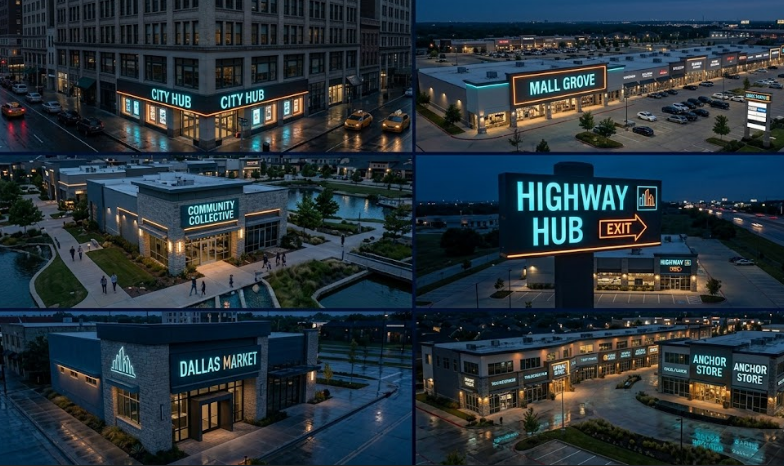
Rolling out signage across 5 locations is fundamentally different from rolling out across 50. The fabrication scales linearly — build 50 signs instead of 5, same process, more volume. Everything else gets exponentially more complex. Permits in 50 different municipalities. Coordination across 50 install dates. Brand consistency across 50 different storefronts in 50 different sign code regimes. HOA approvals at properties you haven't visited. Local labor sourcing in markets where your team has no relationships.
This guide walks through what actually goes into a multi-location sign rollout for a national or regional brand — the phases that matter, the pitfalls that consistently derail rollouts, and how to plan one that finishes on schedule.
Multi-location sign rollouts require coordination, not just multiplied execution. The key facts every brand manager should know:
- Timeline: 50-location rollout typically completes in 7-8 months end-to-end
- Permit variance: 2 weeks (Sun Belt) to 16+ weeks (LA, NYC, SF) per market
- Install order: Sun Belt first · Strict-review markets last
- Fabrication efficiency: 10-20% more efficient than equivalent single-location orders
- Simultaneous launch: Essentially impossible — phased launches are reality
- 5 pitfalls: Incomplete standards · Slow-permit underestimates · No local crews · Skipped surveys · No punch list
Why multi-location rollouts are uniquely difficult
Five things make multi-location rollouts categorically different from single-location sign projects.
1. Permit timeline variance
A 50-location rollout will have permits issued anywhere from week 1 (suburban Texas) to week 16 (Los Angeles, NYC). You can't install signs in markets where permits haven't cleared. The slowest market sets the pace for "completion." See our sign permit timelines by state guide for full per-market timing.
2. Sign code variance
Each municipality has different sign code requirements. A national brand-standard sign that works in 40 cities might need design variances in 10 others because of area limits, height restrictions, or illumination rules. Each variance is a separate process with its own timeline.
3. HOA and landlord approval variance
Some properties require HOA architectural review before permitting. Some leases require landlord approval. These approvals happen on the property's timeline, not yours — and gate the city permit process.
4. Local labor sourcing
A 50-location rollout requires installation crews in 50 markets. Either your sign vendor has regional crew coverage in your install markets, or installation gets bottlenecked on logistics, travel time, and crew availability.
5. Quality control at scale
Checking that location 1 was installed correctly is straightforward. Checking that all 50 locations were installed correctly is a project management exercise. Brand drift happens when local installers make small adjustments that compound across the portfolio.
Incomplete brand standards documentation is the #1 cause of brand drift in multi-location rollouts. If the standard doesn't specify how to handle a sign-code conflict, the local installer will make a decision — and that decision may not match what you want.
Phase 1: Brand standards documentation
Before the first sign is fabricated, the brand standards need to be locked. This document is the source of truth for every fabrication decision and every install decision across all locations. Critical contents:
- Letter forms and proportions. Exact letter heights, stroke widths, kerning, capitalization rules.
- Color specifications. Exact Pantone colors for face material, return color, trim cap color. Specify both lit and unlit appearance.
- Illumination style. Front-lit, halo-lit, open-face, or combination — the same across all locations. See our halo-lit vs front-lit guide.
- Acceptable size ranges. Maximum and minimum letter heights for different building scales.
- Mounting specifications. Distance off the wall, mounting hardware visibility, electrical entry points.
- Sign type alternatives. If a market's sign code prevents the standard sign, what's the approved alternative? (Smaller letters? Box sign substitute? Monument instead of pylon?)
If the brand standards aren't comprehensive, the local installer makes the decision when conflicts arise. That decision may not match what you want, and across 50 locations the small drifts compound into visible inconsistency.
Phase 2: Site surveys
Every location gets a site survey before fabrication starts. The survey captures:
- Building dimensions where signage will mount
- Building material and condition (brick, EIFS, metal panel, stucco, glass)
- Electrical service location and capacity
- Existing signage to be removed (if any)
- Photos of the facade from multiple angles
- Property setback and visibility from public right-of-way
- Adjacent signage for brand consistency context
- Local sign code applicability (zoning district, historic overlay, etc.)
- HOA or landlord approval requirements
Skip the site survey and you'll discover problems at install: mounting surface won't hold sign weight, electrical service is too far for cost-effective conduit run, sign won't comply with local code at the spec'd size, HOA hasn't been notified. Every problem caught at site survey is solved cheaply. Every problem caught at install is expensive.
Phase 3: Permit submissions in coordinated waves
Permits typically go in waves rather than all simultaneously. Wave 1 is fast-permit markets — Texas, Florida, Arizona, Nevada, and most Sun Belt cities. These markets get permits cleared in 2 to 4 weeks. Wave 2 is medium-tier markets (most of the US). Wave 3 is the slow-permit markets — Los Angeles, NYC, San Francisco, Boston, DC, Seattle. These take 8 to 16 weeks each.
The permit sequence matters because fabrication slots are limited. Building 50 signs simultaneously requires a fabrication facility that can handle the volume. Sequencing permits to match fabrication capacity prevents bottlenecks where signs are built but can't be installed because permits aren't ready.
Critical: permit submissions are most efficient when handled by a contractor with established relationships in each market. Out-of-market submissions routinely take 50 percent longer than locally-submitted permits because of unfamiliarity with local procedures, reviewer preferences, and resubmit causes.
Permit timeline variance can reach 8x between markets. A sign that clears Plano, TX in 1-2 weeks can take 12-16 weeks in Los Angeles. This single variable drives most rollout scheduling complexity.
Phase 4: Fabrication coordination
Fabrication for a multi-location rollout is more efficient than equivalent independent single-location projects. The reasons:
- Materials are ordered in bulk — same aluminum, same acrylic colors, same LED modules
- Letter forms are run sequentially — all "A" returns at once, all "B" returns at once
- QC is consistent — same fabrication team applying same brand standards across all units
- Packing and shipping is consolidated by region rather than by individual project
The cost per sign in a 50-location order is typically 10 to 20 percent less than the cost of 50 independent single-location signs. This is one of the few stages where multi-location actually has scale advantages.
The catch: fabrication efficiency requires permit approvals to land in a predictable cadence. If permits arrive randomly across an 18-month window, you can't batch fabrication efficiently. Coordinated permit strategy enables coordinated fabrication.
Phase 5: Dispatch sequencing
Once signs are fabricated and permits are cleared, installation dispatch happens market-by-market. The sequencing typically follows fastest-permit-first:
- Suburban Texas, Phoenix, Las Vegas (weeks 4-8)
- Houston, Dallas, San Antonio, Atlanta, Tampa, Orlando (weeks 6-10)
- Most of the Midwest, Mountain West, Southeast (weeks 8-14)
- Northeast metro suburbs, Pacific Northwest (weeks 10-16)
- Boston, Chicago, Philadelphia core (weeks 12-20)
- Los Angeles, NYC, San Francisco, Seattle, DC (weeks 14-26)
The implication: the first locations are operational with new signage roughly 2 to 3 months after rollout kickoff. The last locations are operational at 6 to 8 months. National rollouts that demand simultaneous launch across all markets are essentially impossible because of permit timeline variance. Phased launches are the practical reality.
Phase 6: Quality control and punch list
Each installation gets a punch-list inspection: was the sign installed to spec, are the brand colors correct, is illumination working, is mounting hardware concealed properly, is electrical operating correctly. The punch list typically catches:
- Minor mounting alignment issues (sign not perfectly level)
- Trim cap separation (manufacturing defect)
- LED failures from shipping damage
- Electrical issues that emerge after first night of operation
- Damage during shipping (scratched faces, dented returns)
Each item gets a repair work order, scheduled during a follow-up service visit typically 2 to 4 weeks after install. Quality multi-location rollouts include a defined punch-list process and a defined timeline for resolution. Without this, individual location issues become permanent compromises.
Sun Belt locations typically install 3 to 6 months before California and NYC locations on the same rollout. Build phased launch expectations into your stakeholder communications from day one. Trying to launch nationally on a single date is fighting permit math you won't win.
Realistic timeline: 50-location rollout phases
Here is what a well-coordinated 50-location sign rollout actually looks like across the calendar, phase by phase.
| Phase | Timing | Key Activities |
|---|---|---|
| Brand standards finalization | Weeks 1–3 | Documentation, design specs, exception handling rules |
| Site surveys scheduled | Weeks 2–6 | Surveys completed across all locations |
| Permit applications submitted | Weeks 3–8 | Coordinated waves by market tier |
| Sun Belt permits issued | Weeks 4–10 | TX, FL, AZ, NV markets clear first |
| Most US permits issued | Weeks 8–16 | Standard-tier markets clear |
| Strict-review permits issued | Weeks 14–22 | LA, NYC, SF, Boston, Seattle, DC clear last |
| Fabrication runs | Weeks 4–24 | Batched by region as permits land |
| Installation rolling | Weeks 6–28 | Region-by-region dispatch |
| Punch list inspections & repairs | Weeks 8–32 | QC at each location, defect resolution |
| Rollout complete | ~Week 32 | All 50 locations operational |
That's about 7 to 8 months end-to-end for a well-coordinated 50-location project. Faster is achievable if every market is in the fast-permit bucket. Slower is common when slow-permit markets dominate the portfolio. Smaller rollouts (5-10 locations) typically complete in 3 to 5 months on the same coordination model.
The pitfalls that consistently derail rollouts
Five patterns show up repeatedly in failed multi-location rollouts.
1. Incomplete brand standards
The brand book has the logo and colors but not the sign specifications. Local interpretations diverge. By location 30, signs don't look like the brand anymore. Fix: comprehensive brand standards before fabrication starts, with explicit handling for sign-code conflicts.
2. Underestimating slow-permit markets
The rollout plan assumes 12-week timelines and runs 28-week timelines in California and NYC. Store openings get delayed because signs aren't ready. Fix: realistic per-market timelines built into the rollout schedule from kickoff.
3. Vendors without local crew coverage
Sign company headquarters is in Texas but installs are happening in Boston, where the contractor is sub-sub-contracting to a local crew with no quality oversight. Fix: vendors with direct regional crew presence in your install markets.
4. Skipping site surveys to save money
Surveys cost a few hundred dollars per location. Skipping them saves a few thousand on a 50-location rollout. The cost of one botched install (wrong sign size, mounting failure, code violation) routinely exceeds the savings from skipped surveys across the entire portfolio. Fix: site surveys are non-negotiable.
5. No punch-list process
Signs get installed but issues never get resolved. By month 6, you have 8 locations with known sign problems and no plan to fix them. Fix: defined punch list, defined repair window, accountability.
Multi-location brands benefit hugely from portfolio maintenance contracts after the rollout. Catching component failures early at year 5-7 (before they cascade) extends operational life across the portfolio and reduces total cost dramatically. See our TCO guide for the long-term math.
The bottom line
Multi-location sign rollouts succeed or fail on coordination — not on the quality of any individual sign, but on the systems for keeping 50 signs consistent across 50 jurisdictions. Brand standards, site surveys, permit sequencing, fabrication batching, dispatch coordination, and punch-list process aren't optional. They're what separates rollouts that finish on schedule from rollouts that drift through year-two and never quite get to "done."
Plan realistically. Lock brand standards before fabrication. Survey every location. Wave permit submissions by market tier. Batch fabrication where you can. Sequence installs by permit clearance. Run a punch list at every location. The result is a rollout that completes in 7-8 months for 50 locations, with consistent brand execution across all markets.
End-to-end coordination across all 50 states
Brand standards documentation, multi-market site surveys, coordinated permit waves, batched fabrication, regional installation crews, and defined punch-list process — included in every multi-location project. Request a consultation for your specific rollout.
Frequently Asked Questions
How long does a multi-location sign rollout take?
What's the difference between single-location and multi-location sign projects?
How do you coordinate permits across multiple cities?
Can all locations launch at the same time?
How do you maintain brand consistency across 50+ locations?
What is a site survey and why is it required?
What pitfalls cause multi-location rollouts to fail?
Do you handle multi-location rollouts in all 50 states?
How does fabrication efficiency scale with multi-location projects?
What factors affect the cost of a multi-location rollout?
American LED Signage is part of a network of commercial lighting and signage specialists supporting multi-location and portfolio projects. For projects beyond storefront signage, see our partner sites: Dallas commercial LED, Fort Worth LED installations, Arlington LED specialists, Plano commercial LED, Irving LED lighting, statewide Texas LED lighting, wholesale LED components, American Starlight Ceilings for premium interior fiber optic, fiber optic lighting systems, modular building solutions, and modular structures in Dallas.