LED Signs in Indianapolis: Retrofits, Message Center Rules & Permit Guide
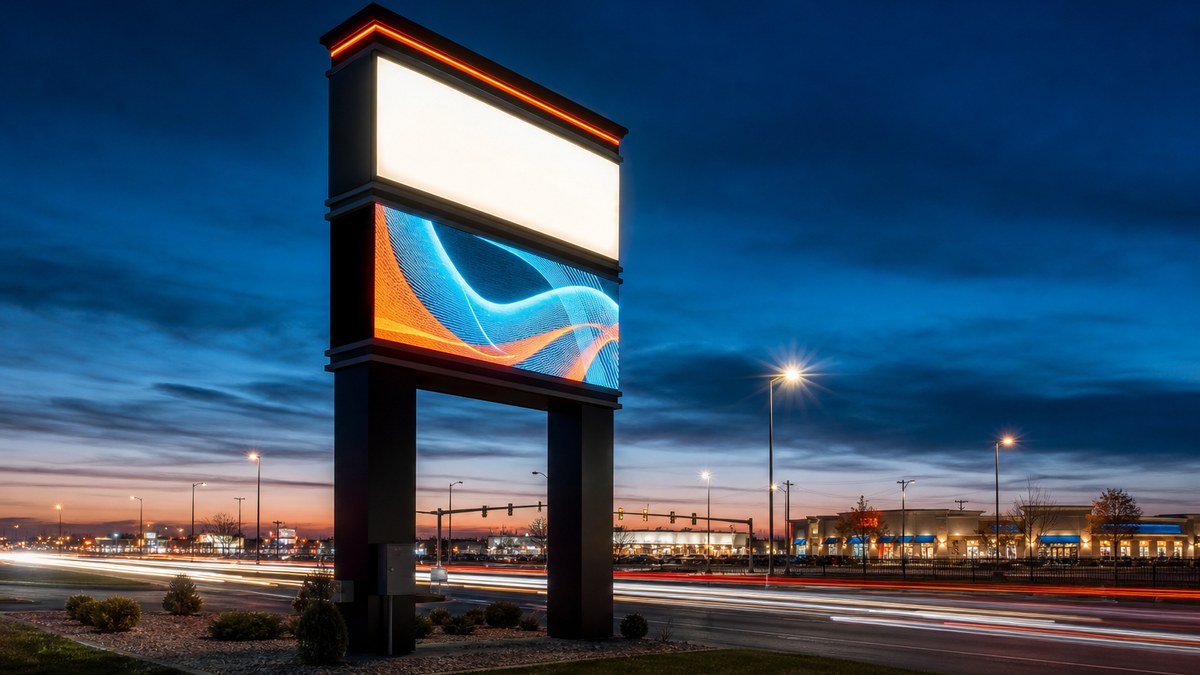
If you own or manage a business on 86th Street, Keystone, Washington Street or anywhere inside I-465, the question is rarely “do we need LED signs in Indianapolis?” It is usually something more specific: can we convert our old fluorescent cabinet to LED, can we add an electronic message center to the pylon, and what will the city (or Fishers, Carmel or Noblesville) actually allow? This guide answers those questions for LED signs in Indianapolis and the Hamilton County suburbs.
Indianapolis is a retrofit market. Thousands of pylon cabinets, box signs and channel letters along the city’s commercial corridors were built in the fluorescent and neon era. Many still stand on structurally sound poles, and many sit on lots where a brand-new sign would face tighter rules than the old one. Knowing when to retrofit, when to repair and when to replace — and how the local electronic sign rules work — saves months and avoids a rejected permit.
Below we cover the Indianapolis-Marion County sign permit process, the electronic variable message sign (EVMS) rules, how nonconforming signs are treated, what changes in Fishers, Carmel and Noblesville, which Indiana electrical and building codes apply right now, and how to build a sign that survives central Indiana winters, hail and lightning.
Most new or altered LED signs in Indianapolis need an Improvement Location Permit (ILP) from the city, plus electrical work by a licensed contractor. Electronic message centers face the strictest rules:
- Permit: ILP for any non-exempt sign, filed online through the city’s Accela Citizen Access portal
- EMC districts: EVMS allowed in C-4, C-5, C-6, C-7, C-ID, C-S and industrial districts (published sign regulations)
- EMC limits: 15-second minimum message hold, no motion or flashing, max 40% of the sign, auto-dimming required
- Distances: 600 ft from protected (residential) districts, 125 ft from signalized intersections
- Suburbs differ: Noblesville 10-second hold and 30% cap; Carmel and Fishers are far more restrictive
- Codes in force: 2009 Indiana Electrical Code (2008 NEC basis) — a 2023 NEC update is adopted but not yet effective
- LED retrofit: typically 60–70% less energy than fluorescent, with 50,000–100,000-hour LED modules
Why Indianapolis is a retrofit-first sign market
Drive Pendleton Pike, Lafayette Road or US 31 on the south side and you will see the pattern: tall steel pylons with internally lit plastic faces, most installed decades ago. Fluorescent tubes inside those cabinets dim, flicker in cold weather and need frequent ballast replacement. Neon on older channel letter signs fails at the transformer. Owners want brighter, cheaper-to-run signs, and many want to add a digital message center.
The catch is that the sign rules have changed since many of those signs were permitted. A sign that was legal when installed can now be “legally nonconforming” — taller, larger or closer to the road than today’s rules allow. Tear it down and you may be forced to build something smaller. Keep the structure and upgrade what is inside it, and you can often keep the size and height you already have.
That is why the first question on most Indianapolis projects is not “what should the new sign look like?” but “what can we keep?” A good site survey answers it: pole condition, foundation condition, cabinet condition, electrical service, and the zoning district the sign sits in.
Before you design anything, pull the property’s zoning district from the city’s GIS map. Whether you are in C-3 or C-4 decides whether an LED message center is even on the table — and that one fact changes the whole project.
The Indianapolis sign permit process
Indianapolis and Marion County share a consolidated zoning ordinance. Signs are regulated in the sign regulations of that ordinance (now Chapter 744, Article IX of the Consolidated Zoning/Subdivision Ordinance, which replaced the older stand-alone Chapter 734 sign regulations). Permits are handled by the city’s Department of Business and Neighborhood Services and filed online through Accela Citizen Access.
What needs a permit
Under the published sign regulations, any sign that is not on the exempt list needs an Improvement Location Permit (ILP). The exempt list covers small and temporary items — real estate signs, construction signs, small incidental signs, garage sale signs and similar. Permanent business signs, illuminated signs and freestanding signs are not on that list. If it lights up and stays up, plan on a permit.
Routine maintenance and copy changes that do not change the sign’s area or height, and do not create or increase a nonconformity, have generally not required a new ILP. Converting an old cabinet’s internal lighting to LED can fall on either side of that line depending on the scope, so confirm with the city before work starts. Adding an electronic message center is never “maintenance” — it is a new sign element with its own rules.
What the application usually includes
- Site plan showing the sign location, property lines, right-of-way and setbacks
- Dimensioned sign drawings with area, height and clearance
- Building elevations for wall signs, with facade dimensions
- Structural and foundation details for freestanding signs, typically sealed by an engineer
- Owner or landlord authorization — the regulations prohibit placing a sign without the property owner’s written consent
- Electrical information for illuminated signs, with work by a licensed electrical contractor
Indianapolis licenses electrical and general contractors through the city, with bonding and insurance requirements. Expect the electrical connection for any illuminated sign to be pulled and inspected separately from the zoning and structural review. For a broader look at how review times compare across the country, see our sign permit timelines by state.
| Project Type | Typical Review Path | Main Risk |
|---|---|---|
| Wall channel letters | ILP + electrical | Facade area allowance, landlord criteria |
| Cabinet LED retrofit | Electrical; ILP if scope changes the sign | Nonconforming status, UL labeling |
| New monument sign | ILP + structural + electrical | Setbacks, sight lines at drives |
| New pylon sign | ILP + sealed structural + electrical | Height limits by district, foundation design |
| Adding an LED message center | ILP (EVMS review) + electrical | Zoning district, 600 ft residential distance |
| Inside a historic or overlay area | Added design review | Lighting style, materials, size |
Electronic message center rules in Indianapolis
Electronic message centers — called electronic variable message signs (EVMS) in the city’s regulations — are where most Indianapolis sign projects succeed or fail. The published EVMS section of the Indianapolis-Marion County sign regulations sets these limits:
- Allowed districts: C-4, C-5, C-6, C-7, C-ID, C-S and industrial districts
- Size: the electronic portion may be no more than 40% of the sign
- Distance from homes: at least 600 feet from a protected district (residential and similar)
- Distance from intersections: at least 125 feet from signalized thoroughfare intersections
- Message hold: each message displays for at least 15 seconds
- Effects: no motion, animation or flashing
- Brightness: automatic dimming with a light sensor is required
- Fail-safe: the display must go dark or blank if it malfunctions, and glare complaints must be corrected within 24 hours of notice
Separately, the regulations prohibit flashing or animated signs in dwelling districts, special use districts, the C-1, C-2 and C-3 commercial districts and the central business districts, and within 600 feet of any protected district. In plain terms: an LED message center on a neighborhood commercial strip that backs up to houses is usually a non-starter, while a C-4 or C-5 corridor site with no homes nearby is usually workable.
Indianapolis consolidated its zoning code in 2016, and sign sections have been amended since. The numbers above come from the city’s published sign regulations; always confirm against the current Chapter 744 text and the property’s zoning before ordering a display.
What a 15-second hold means for design
A 15-second minimum hold is long compared with the 8-second hold common in many cities. On a road where traffic moves at 40 mph, a driver may see only one message per pass. That changes how you write content: one idea per screen, large type, high contrast, and no multi-frame stories that depend on the driver seeing three screens in a row.
It also changes what hardware you need. If the sign will show mostly static text and simple graphics, you do not need the finest pixel pitch on the market. Our programmable LED sign buyer’s guide explains how to match pixel pitch to viewing distance, and our LED message centers page shows the cabinet options.
Nonconforming signs: retrofit, repair or replace?
This is the most important section for Indianapolis property owners with older signs. The sign regulations allow a legally established nonconforming sign to remain “without alteration in size or location.” Maintenance, repainting and posting of copy are allowed. But there are two hard limits:
- The two-thirds rule: if a nonconforming sign is damaged beyond two-thirds of its replacement value, it may only be rebuilt in conformance with current rules.
- The abandonment rule: a sign or sign structure that is no longer functional or is abandoned must be removed within 30 days.
Those two rules drive real decisions. A storm that wrecks a tall nonconforming pylon can turn a 30-foot sign into a much shorter one. A dark, neglected sign can lose its status entirely. Keeping an older sign working and maintained is how you protect the size and height you already have.
The three paths
| Path | When It Fits | What Changes |
|---|---|---|
| Repair | Sign under ~10 years, one section or letter out | Power supply, LED module or wiring replaced |
| LED retrofit | Sound pole, foundation and cabinet; fluorescent or neon lighting | Lighting converted to LED; new faces optional |
| Replace | Structural damage, corrosion, rebrand, or new EMC needed | New sign built to current rules |
For the full decision framework, including the 30% and 60% repair-to-replacement rule of thumb, read sign repair vs replace. For ongoing care, see our sign repair and maintenance service.
How an LED sign retrofit works
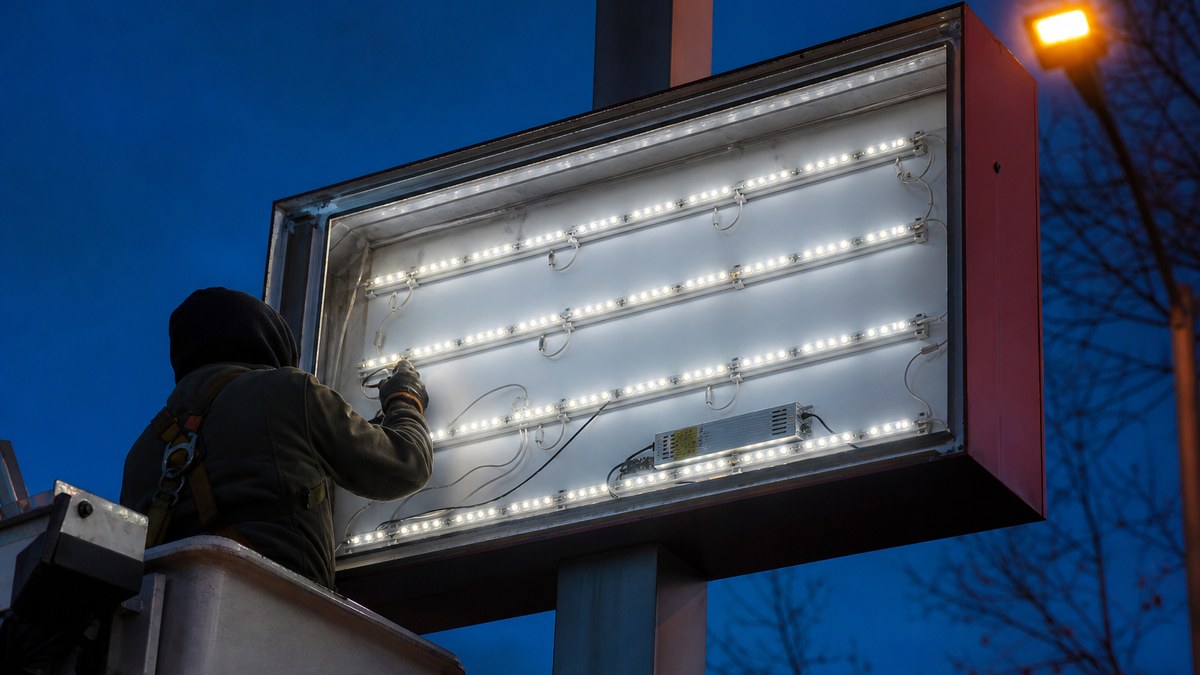
“LED sign retrofitting” is one of the most searched sign services in Indianapolis, and for good reason. A retrofit keeps the pole, foundation and cabinet and replaces the light source. Done right, it is faster than a new sign, keeps your existing structure in service, and typically cuts lighting energy use by 60–70% compared with fluorescent tubes.
Step 1: Survey the structure
A retrofit only makes sense if the structure is worth keeping. The technician checks the pole for rust at the base, the anchor bolts and base plate, the cabinet frame, retainers, seams and the face condition. If the steel is sound, the cabinet can usually take LED modules. If the base is rusted through, a retrofit is money spent on a sign that may need to come down anyway.
Step 2: Choose a listed retrofit kit
Converting a sign’s lighting changes the sign’s electrical design. Signs are listed under UL 48 (electric signs), and LED retrofit kits for signs are covered by UL 879A. Using a listed retrofit kit, installed by a qualified installer and marked per the kit’s instructions, keeps the sign’s safety listing intact. Mixing random LED strips and unlisted power supplies is how cabinets end up failing inspection — or catching fire.
Step 3: Replace ballasts with LED power supplies
Old fluorescent ballasts and neon transformers come out. Class 2 LED power supplies go in, sized with headroom and placed where they can shed heat and be reached for service. In Indianapolis winters, use power supplies rated for cold starts so the sign lights reliably on a single-digit morning.
Step 4: Re-face if needed
Twenty-year-old acrylic or polycarbonate faces are often yellowed and brittle. New faces brighten the sign as much as the LEDs do, and impact-modified materials resist central Indiana hail. A re-face with the same dimensions keeps the sign’s footprint unchanged.
Step 5: Electrical connection and disconnect
NEC Article 600 requires a disconnecting means for each sign and sets rules for sign circuits and grounding. A licensed electrician confirms the circuit, the disconnect location and the bonding, and the work is inspected.
Fluorescent sign tubes typically last 8,000–12,000 hours. Quality LED modules are rated for 50,000–100,000 hours, and power supplies are usually the first part to need replacement, often after 5–7 years. See the true cost of LED sign ownership for how that plays out over 15 years.
Retrofit, repair or a new LED message center?
We survey your existing sign, check your zoning district against the EMC rules, and give you a clear recommendation with a project-specific quote and timeline.
Pylon, monument and wall signs: size and placement basics
Every district has its own height and area limits, and the numbers change between commercial districts. Under the city’s older published sign regulations, pole signs were capped at 25 feet in the lighter commercial districts (C-1, C-2, C-3C) and 40 feet in the heavier commercial and industrial districts, with the lowest point of a pole sign at least 9 feet above grade and a 15-foot setback from the right-of-way. Ground signs were held to a low height. Wall sign allowances were set as a percentage of the facade, with the front facade getting the largest share. Treat these as orientation, not design numbers — confirm the current Chapter 744 tables for your district.
Pylon signs
Tall pylon signs make sense on arterial and highway frontage where speeds are high and setbacks are deep. Near interstates, the regulations have allowed taller freeway-oriented signs in limited locations, with no video or animated displays. Any new pylon needs a foundation engineered for the site — see our pylon sign foundation engineering guide.
Monument signs
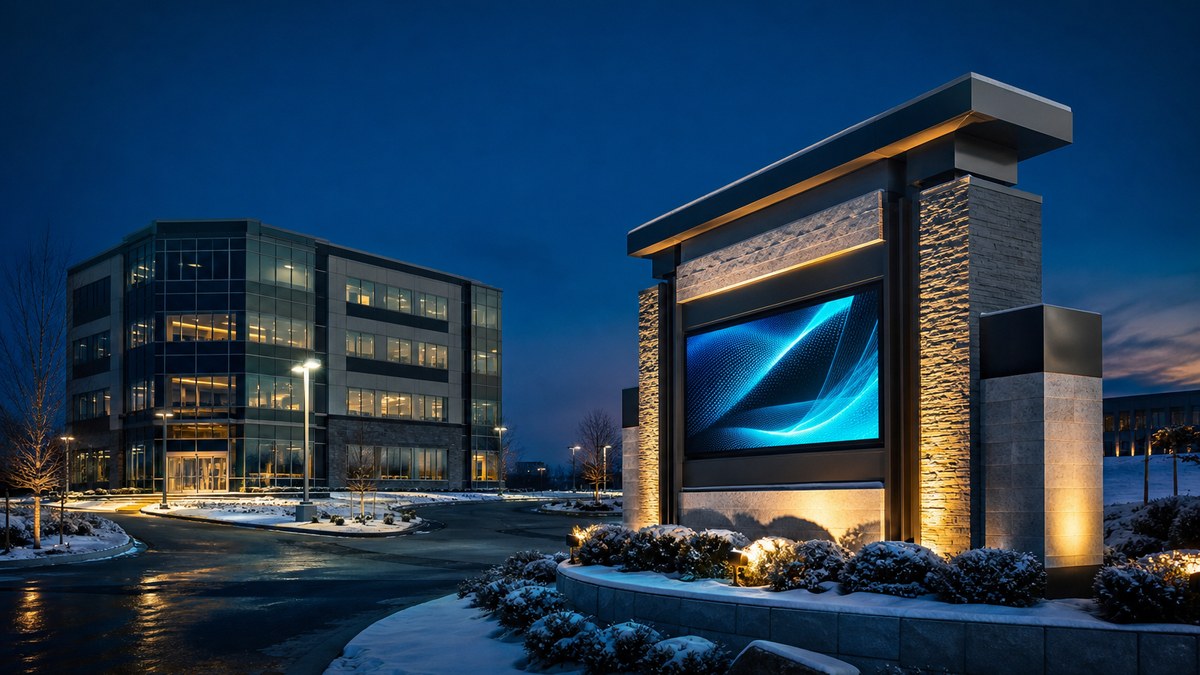
Monument signs are the default choice for office parks, medical buildings, churches and newer retail along suburban corridors. In Hamilton County cities they are often the only freestanding option. A monument with an integrated message center is common where the district allows EMCs.
Wall signs and channel letters
For storefronts, wall signs and illuminated channel letters are usually the fastest path to permit. Landlord sign criteria often matter as much as the city code in shopping centers. Older lighted box signs are prime retrofit candidates.
Hamilton County suburbs: Fishers, Carmel and Noblesville
Many “Indianapolis” sign projects are actually in Hamilton County, and each city writes its own sign code. The difference from Indianapolis can be dramatic, especially for electronic signs.
Noblesville
Noblesville’s Unified Development Ordinance (sign article, 2019 version) allows electronic signs only as part of permanent on-premise ground signs. The rules include a 10-second minimum message hold with no scrolling, fading or transitions; an electronic area of no more than 30% of the sign; brightness limits of 5,000 nits during the day, dimming to 500 nits from 30 minutes after sunset until sunrise; and 1,320 feet of separation from another electronic sign on the same frontage. Electronic signs are not allowed downtown except time-and-temperature displays. See our Noblesville LED signs page.
Carmel
Carmel is known for strict sign standards. Its UDO prohibits flashing or animated signs except public service information from the city or state, and the city’s sign guide limits electronic message boards to drive-thru signs that change no more than once every 10 seconds. Multi-tenant buildings typically need an approved sign package through Carmel’s ADLS (architectural design, lighting and signage) review. Plan for design review time on almost any Carmel project.
Fishers
Fishers prohibits signs with moving parts or flashing, animated or intermittent illumination, apart from time, date or weather displays, and has kept its ban on digital billboards. Digital changeable copy generally requires relief from the Board of Zoning Appeals, and variances have been denied. For most Fishers businesses, the better investment is excellent static illumination — halo-lit or front-lit channel letters and a well-lit monument. Visit our Fishers LED signs page for local details.
| Jurisdiction | Electronic Message Centers | Key Numbers |
|---|---|---|
| Indianapolis | Allowed in C-4 to C-7, C-ID, C-S, industrial | 15-sec hold, 40% max, 600 ft from residential |
| Noblesville | Ground signs only, not downtown | 10-sec hold, 30% max, 5,000/500 nits |
| Carmel | Drive-thru boards only | No more than one change per 10 sec |
| Fishers | Generally prohibited | Time/date/weather exception; variance needed |
| INDOT (state highways) | Changeable message billboards | 8-sec static, 2-sec change, 0.3 fc above ambient |
Highway frontage and digital billboards
Signs along interstates and state highways also answer to the state. Indiana law defines a changeable message sign as one whose static display lasts at least 8 seconds, with each change taking no more than 2 seconds. INDOT’s outdoor advertising rule (105 IAC 7-4-5) requires an automatic light sensor, limits brightness to 0.3 foot-candles above ambient light, requires 300 feet from a residence unless the owner consents in writing, requires the display to default to static or dark if it malfunctions, and requires driver-interference problems to be fixed within 12 hours of INDOT’s request.
Indianapolis adds its own billboard rules on top: billboards are limited to certain commercial and industrial districts, must be spaced at least 1,000 feet apart, and are kept away from protected districts. Inside I-465, the regulations keep billboards well back from freeway rights-of-way. If you are considering a digital billboard, the zoning and state permit review comes first and design second.
Indiana codes in force: electrical and building
Indiana adopts state codes through the Fire Prevention and Building Safety Commission, and the state has lagged the national model codes for years. As of late 2026:
- Electrical: the 2009 Indiana Electrical Code (675 IAC 17), based on the 2008 National Electrical Code, remains the commercial code in force. A new Indiana Electrical Code based on the 2023 NEC was adopted by the Commission in August 2026, but it takes effect only after state approvals and filing — expect 2027 at the earliest.
- Building: the 2014 Indiana Building Code, based on the 2012 IBC, still governs. An update based on the 2024 IBC is in the rulemaking process.
For sign work, the practical effect is that NEC Article 600 rules on sign disconnects, grounding and listing apply now under the 2008 text, and inspectors will move to the 2023 text once the new code takes effect. A sign designed to the newer requirements today will not be caught out by the change. Structural design for freestanding signs follows the wind provisions tied to the building code in force, so your engineer should state which wind speed and edition the calculations use.
Building for central Indiana weather
Indianapolis is not a hurricane market, but its weather is hard on signs in its own way. The city averages about 25.5 inches of snow a year, swings through dozens of freeze-thaw cycles each winter, uses road salt heavily, and sees severe thunderstorms with hail, lightning and straight-line winds from spring through summer. Indiana averages about 22 tornadoes a year.
Cold and freeze-thaw
Water that gets into a sign cabinet freezes, expands and opens seams further. Every cabinet and channel letter needs sealed seams, clear weep holes at the low points, and drip loops on wiring entries. Power supplies should be cold-start rated.
Salt
Plow spray reaches monument signs and pole bases along every major road. Use stainless or coated hardware, keep steel bases painted, and inspect anchor bolts every spring after salt season.
Hail and storms
Impact-modified faces resist hail far better than thin standard acrylic. LED message centers benefit from surge protection on both power and data lines, because lightning-induced surges are a common cause of dead or scrambled displays after a storm.
Foundations
Footings must extend below the frost line — typically 30–36 inches in central Indiana, but confirm the local requirement. Pylon foundations are engineered for the site’s wind exposure and soil, which often means drilled piers well below frost depth.
| Indiana Condition | What Fails | Spec That Prevents It |
|---|---|---|
| Freeze-thaw cycles | Seams, faces, wiring entries | Sealed seams, weep holes, drip loops |
| Cold mornings | Fluorescent and cheap drivers | Cold-start UL-listed LED power supplies |
| Road salt | Pole bases, anchor bolts, hardware | Stainless/coated hardware, spring inspection |
| Hail | Thin acrylic faces | Impact-modified or polycarbonate faces |
| Lightning | Message center controllers | Surge protection on power and data |
| Frost heave | Shallow footings | Footings below local frost depth |

What drives the cost of an Indianapolis LED sign
Every sign is quoted individually, because the variables are real and they stack. The biggest cost drivers are:
- Retrofit vs new structure: keeping a sound pole and foundation removes the largest structural cost.
- Sign size and height: larger cabinets need more LEDs, heavier steel and bigger foundations.
- Message center specs: pixel pitch, full-color vs monochrome, single vs double face.
- Engineering: sealed structural drawings and soil information for freestanding signs.
- Electrical: new circuits, trenching to a monument, disconnects and surge protection.
- Permits and reviews: overlay or design review in Carmel, historic areas or special districts.
- Access: crane or bucket truck needs, traffic control on busy corridors.
The fastest way to a real number is a site survey and a free quote. Browse our gallery for project types and our full list of services.
Typical project timeline
Timelines vary by jurisdiction, district and sign type, so treat these as typical ranges, not promises:
- Survey and zoning check (1–2 weeks): structure condition, district, distances to residential and intersections.
- Design and engineering (1–3 weeks): drawings, structural calculations for freestanding signs.
- Permits (a few weeks; longer with design review): ILP and electrical in Indianapolis; ADLS in Carmel; BZA if a variance is needed.
- Fabrication (runs during permitting): cabinets, faces, letters or message center.
- Install and inspection (1–3 days on site for most signs): plus foundation cure time for new pylons.
Multi-site operators rolling out across Indianapolis, Columbus and Chicago should stagger permits by city — our multi-location rollout guide shows how. We also serve Columbus, OH and Chicago, and every market on our locations page.
Keeping it working: an Indiana maintenance schedule
A sign that stays lit keeps its nonconforming status, its curb appeal and its value. For central Indiana, we recommend two inspections a year:
- Fall (before first freeze): seals, weep holes, power supply health, photocell and dimming, face cracks.
- Spring (after salt season): pole base and anchor bolt corrosion, hardware, storm damage, surge protector status.
- After any severe storm: check for loose faces, leaning poles and message center errors.
Our commercial LED sign maintenance guide has the full checklist.
Frequently Asked Questions
Do I need a permit for an LED sign in Indianapolis?
Almost always. Under the Indianapolis-Marion County sign regulations, any sign that is not on the exempt list needs an Improvement Location Permit (ILP). Permanent business signs, illuminated signs and freestanding signs are not exempt. Electrical work for illuminated signs is done by a licensed contractor and inspected separately. Applications are filed online through the city's Accela Citizen Access portal.
Can I add an LED message center to my sign in Indianapolis?
It depends on your zoning district and location. The city's published sign regulations allow electronic variable message signs in the C-4, C-5, C-6, C-7, C-ID, C-S and industrial districts, at least 600 feet from protected residential districts and 125 feet from signalized intersections. The electronic portion is limited to 40% of the sign. Confirm the current Chapter 744 text for your property before ordering a display.
How long must a message stay on an Indianapolis LED sign?
The city's published electronic sign rules require each message to display for at least 15 seconds, with no motion, animation or flashing, and automatic dimming. Noblesville requires a 10-second hold, Carmel limits electronic boards to drive-thru signs changing no more than once every 10 seconds, and INDOT requires at least 8 seconds for changeable message billboards on state highways.
Can I retrofit my old fluorescent sign to LED instead of replacing it?
Usually, if the pole, foundation and cabinet are structurally sound. An LED retrofit replaces fluorescent tubes and ballasts with LED modules and Class 2 power supplies, typically cutting lighting energy use by 60 to 70 percent. Use a listed sign retrofit kit (UL 879A) installed per its instructions so the sign keeps its safety listing, and confirm with the city whether your retrofit scope needs a new permit.
What happens to a nonconforming sign in Indianapolis?
A legally established nonconforming sign can stay without changes to its size or location, and it can be maintained and repainted. If it is damaged beyond two-thirds of its replacement value, it may only be rebuilt to current rules. A sign that is no longer functional or is abandoned must be removed within 30 days. Keeping an older sign maintained protects its existing size and height.
Are electronic signs allowed in Fishers or Carmel?
Both cities are restrictive. Fishers prohibits flashing, animated or intermittent illumination except time, date or weather displays, keeps a ban on digital billboards, and generally requires a variance for digital changeable copy. Carmel prohibits flashing or animated signs except public service information and limits electronic message boards to drive-thru signs. Noblesville allows electronic signs on permanent ground signs with a 10-second hold and a 30 percent area limit.
Which electrical code applies to sign work in Indiana?
As of late 2026, commercial work follows the 2009 Indiana Electrical Code, based on the 2008 National Electrical Code. A new Indiana Electrical Code based on the 2023 NEC was adopted by the Fire Prevention and Building Safety Commission in August 2026 but takes effect only after state approvals and filing. NEC Article 600 governs signs, including disconnects, grounding and listing.
How deep do sign footings go in Indianapolis?
Footings must extend below the frost line, typically 30 to 36 inches in central Indiana, but the local building department sets the requirement. Pylon sign foundations are engineered for the site's wind exposure and soil and are usually drilled piers well below frost depth. Monument signs use shallower engineered footings that still go below frost.
How much does an LED sign cost in Indianapolis?
Every sign is quoted individually. The main cost drivers are whether you retrofit an existing structure or build new, sign size and height, message center specifications, structural engineering, electrical work such as trenching and surge protection, permits and design review, and access needs like cranes or traffic control. Request a free quote with a site survey for a project-specific number and timeline.
How do I protect an LED sign from Indiana winters?
Specify sealed seams and clear weep holes so meltwater drains, drip loops on wiring entries, cold-start rated UL-listed power supplies, stainless or coated hardware to resist road salt, impact-modified faces for hail, and surge protection for message centers. Inspect every fall before the first freeze and every spring after salt season.
Get your Indianapolis sign done right the first time
From LED retrofits of older pylons to new monument signs with message centers, we handle design, engineering, permits and installation with UL-listed components and multi-year warranties.
American LED Signage is part of a network of commercial lighting and signage specialists. For projects beyond signage, see our partner sites: Dallas commercial LED, Fort Worth LED lighting, Arlington LED specialists, Plano commercial LED, Irving LED installations, statewide Texas LED lighting, wholesale LED components, American Starlight Ceilings for premium interior fiber optic ceilings, fiber optic lighting systems, modular building solutions, and modular structures in Dallas.