Commercial LED Sign Repair in Houston: Maintenance, Storm Damage & Permit Guide
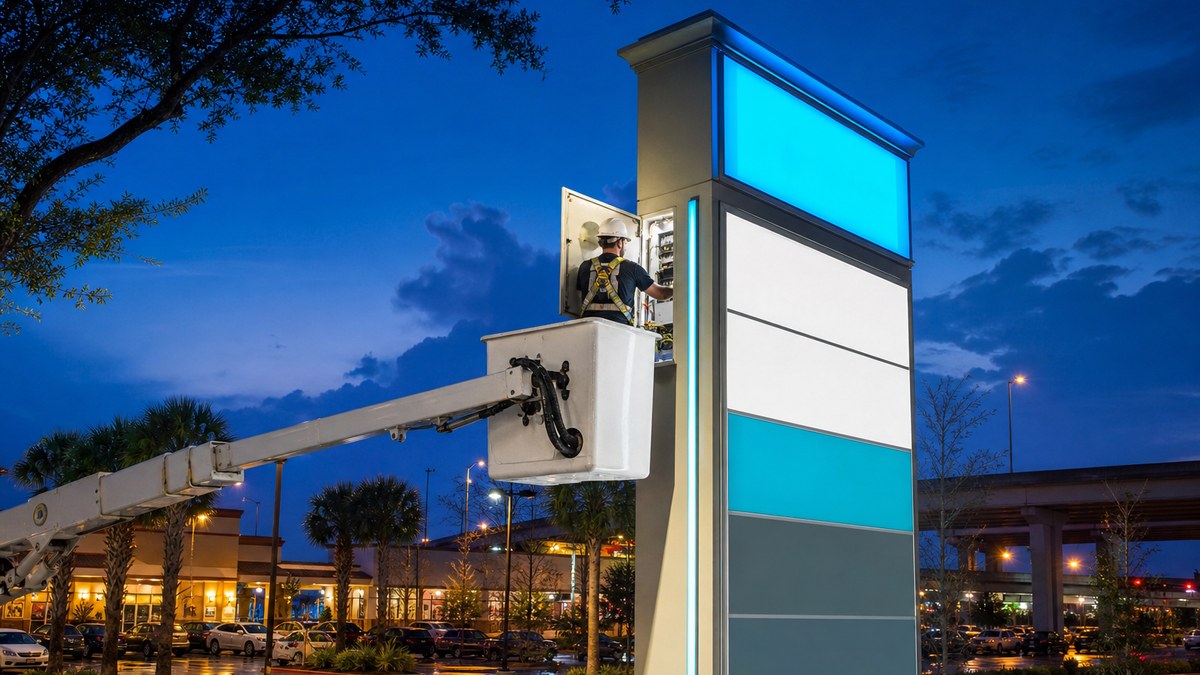
Commercial LED sign repair in Houston is a different job than sign repair in most American cities. Your sign lives through heat that cooks power supplies, humidity that corrodes connections, lightning season, and storms like the 2024 derecho and Hurricane Beryl that bent poles and blew faces out of cabinets across the metro. On top of the weather, the City of Houston treats most sign repair as permitted work that only a licensed sign contractor can perform.
This guide explains how Houston signs fail, what a good maintenance schedule looks like for Gulf Coast conditions, when repair needs a permit, how to handle storm damage and insurance documentation, and when it makes more sense to retrofit or replace. It is written for property managers, franchise owners, facility teams and business owners with channel letters, pylon signs, monument signs and LED message centers anywhere in Greater Houston. If you need help now, our sign repair and maintenance team covers Houston and the surrounding suburbs.
Houston LED sign repair is driven by heat, humidity, lightning and storms, and most repair work inside the city requires a permit pulled by a licensed sign contractor:
- Who can do it: Exterior sign work for others in Houston requires a City of Houston sign contractor license; electrical work needs a TDLR-licensed Master or Master Sign Electrician
- Permits: Houston requires permits before signs are erected, altered or repaired, plus electrical inspection for electric signs
- Top failures: Power supplies (drivers), water intrusion, corroded connections, surge damage, faded or cracked faces
- Inspection rhythm: Twice a year in Houston — before hurricane season (spring) and after it (fall)
- Storm benchmarks: Beryl gusts reached 84 mph at Hobby Airport (NWS); the 2024 derecho brought winds near 100 mph downtown
- LED lifespan: Quality LEDs are rated 50,000–100,000 hours, but drivers usually fail first in Gulf heat
Why Houston is hard on LED signs
An LED sign is a sealed electrical system living outdoors. Every climate attacks it differently. Houston attacks it from four directions at once, which is why the same sign that runs trouble-free for a decade in Denver or Phoenix may need attention every few years on the Gulf Coast.
Heat and sun load
Houston summers bring long stretches in the mid to upper 90s with heat index values well above 100. A dark sign cabinet in full sun gets much hotter inside than the air around it. Heat is the enemy of LED power supplies: the electrolytic capacitors inside them age faster as temperature rises. A common engineering rule of thumb is that capacitor life roughly halves for every 10°C increase in operating temperature. That is why power supplies, not the LEDs themselves, are the most common failure in Houston signs.
Humidity and condensation
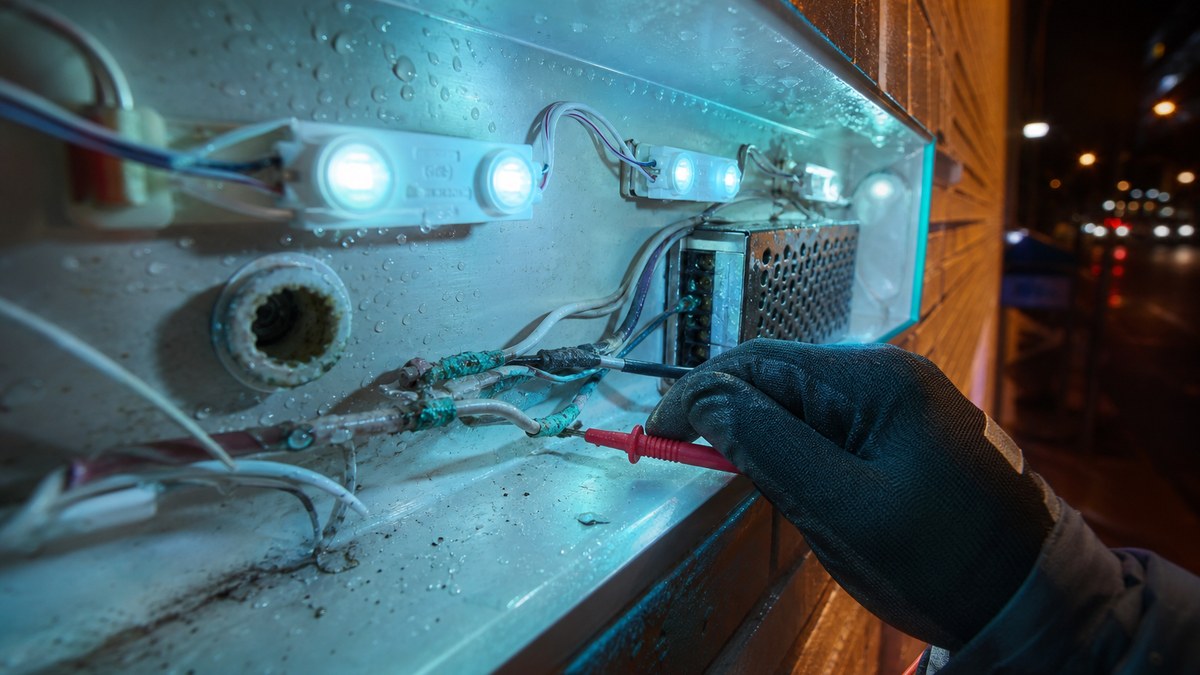
Houston air holds a lot of moisture almost year-round. When a hot cabinet cools overnight, humid air inside it condenses on metal surfaces, circuit boards and wire splices. Over time that moisture corrodes connectors, grows green oxidation on copper, and creates the intermittent flicker that is so hard to diagnose. Weep holes that are clogged by dirt, insects or wasp nests make it worse by trapping water inside the letter or cabinet.
Lightning and power quality
The Gulf Coast sees frequent summer thunderstorms. A nearby strike or a utility switching event can send a voltage spike into your sign circuit. LED message centers are especially sensitive because they contain controllers, receiving cards and communication hardware as well as LED modules. Surge damage often shows up as a dead section, scrambled content or a controller that will not boot.
Wind, rain and hurricanes
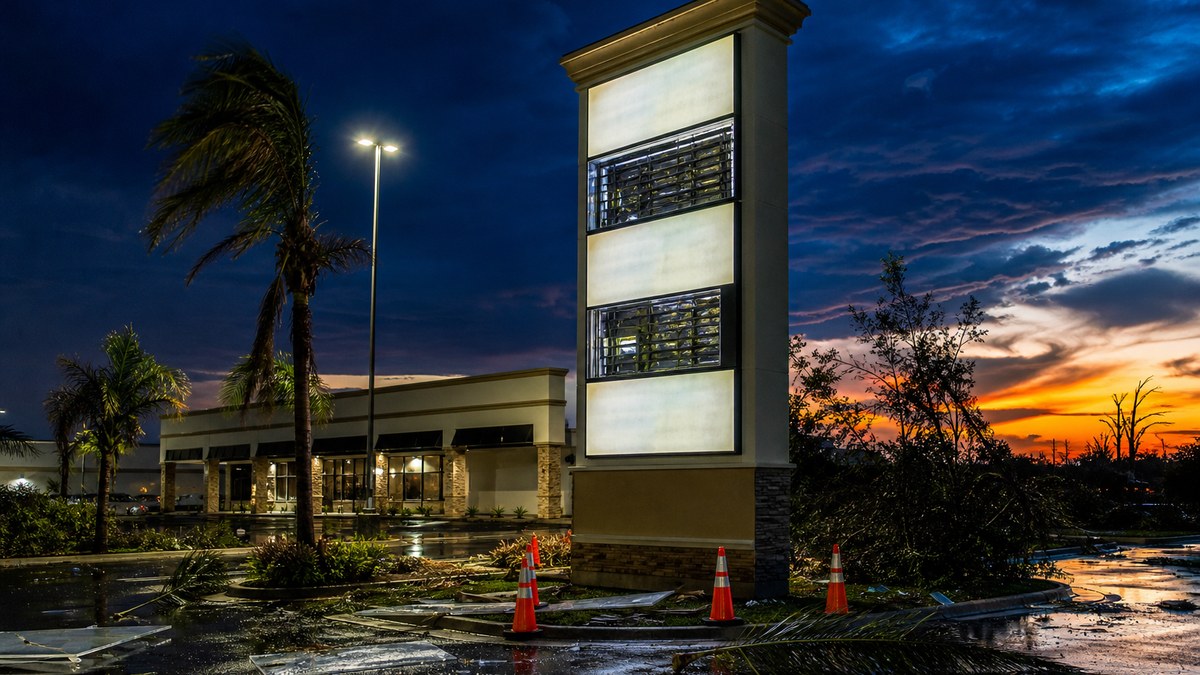
Houston sits in a hurricane-prone wind region, and recent storms proved the risk is not theoretical. During Hurricane Beryl in July 2024, the National Weather Service recorded peak gusts of 84 mph at Houston Hobby and 83 mph at Bush Intercontinental, and more than two million customers lost power. Two months earlier, the May 2024 derecho pushed winds near 100 mph through downtown. Both storms left torn faces, twisted channel letters, leaning pylons and flooded sign electrical across the region.
If your sign was damaged by a storm and you never got it fully inspected, do it now. Wind can loosen anchor bolts, crack welds and open seams without any visible damage from the parking lot. The next storm finds the weak point first.
The most common LED sign failures we see in Houston
Most Houston repair calls fall into a short list of problems. Knowing the symptoms helps you describe the issue clearly when you request service, which speeds diagnosis and helps the crew bring the right parts on the first visit.
| Symptom | Likely Cause | Houston Factor | Typical Fix |
|---|---|---|---|
| Whole letter or section dark | Failed LED power supply | Heat | Replace driver with UL-listed unit, check ventilation |
| Flickering or intermittent lighting | Corroded splice or loose connector | Humidity | Re-terminate with sealed connectors |
| Message center dead or scrambled | Controller or receiving card damage | Lightning | Replace electronics, add surge protection |
| Water inside letters or cabinet | Blocked weep holes, failed seals | Rain | Clean weeps, reseal seams and penetrations |
| Faded, chalky or cracked faces | UV breakdown of acrylic or polycarbonate | Sun | Replace faces with UV-stable material |
| Leaning pole or loose cabinet | Wind damage, corroded hardware | Storms | Structural inspection, possible engineered repair |
| Dead pixels or color blocks | Failed LED module | Heat + age | Swap module, match batch for color |
Power supply failures
When one letter or one half of a lighted cabinet goes dark at the same time, the driver feeding that section is the first suspect. In Houston, drivers mounted in sealed, unvented spaces or on sun-facing walls fail early. A good repair replaces the driver with a UL-listed unit rated for the actual load and the outdoor temperature range, and moves it to a cooler, accessible location when possible so the next service call is faster.
Connection corrosion
Twist-on wire nuts and unsealed splices that work fine in dry climates often fail in Houston. Corrosion raises resistance, which creates heat and voltage drop, which causes the dim or flickering sections that customers notice first. The long-term fix is sealed, gel-filled or heat-shrink connectors and proper drip loops on every wire entry.
Message center electronics
Programmable displays have more parts that can fail: LED modules, receiving cards, sending hardware, cooling fans, temperature sensors and the light sensor that dims the sign at night. A failed light sensor in Houston is a code problem, not just a cosmetic one, because a display stuck at daytime brightness after dark can violate the brightness limits in the city’s electronic sign rules. Our programmable LED sign buyer’s guide explains brightness and dimming in more detail.
Do you need a permit to repair a sign in Houston?
Often, yes. This surprises many owners who assume a repair is just maintenance. The City of Houston’s Sign Administration states that permits must be obtained before signs are erected, altered or repaired, and that sign permits are issued only to licensed sign contractors. Electric signs also go through electrical inspection.
Who is allowed to work on your sign
- City sign contractor license: Anyone doing exterior sign work for others inside Houston’s sign code area must hold a license from Houston Sign Administration, renewed every year, backed by bonds and proof of insurance.
- Licensed electrician: Electrical sign work requires a dedicated Master Electrician or Master Sign Electrician licensed by the Texas Department of Licensing and Regulation (TDLR) and registered with the city’s electrical inspections division.
- Owner exceptions are narrow: A business owner can only permit certain small non-electrical signs and must do all the work personally. Illuminated LED signs do not qualify.
Repair, refurbishment or new sign?
Houston separates work into categories. Restoring a sign to like-new condition is refurbishment. Changing the sign — enlarging it, reducing it, retrofitting it or altering it — is treated like new sign work and must meet current code. That matters most for older grandfathered (non-conforming) signs. Houston has a specific refurbishment permit for non-conforming on-premise signs that allows restoration, life-safety maintenance and repair of limited damage, with plan review and several inspections, including a shop inspection for electrical signs. If your older pylon is non-conforming, a careless “upgrade” can trigger new-sign rules and cost you the grandfathered size or height.
Outside Houston city limits
Greater Houston is a patchwork of cities. South Houston, Pasadena, Sugar Land, Pearland, League City, Baytown and Katy each have their own sign ordinances and permit desks, and unincorporated areas fall under county and state rules. Areas like The Woodlands may add private covenant review on top. The electrical licensing requirement is statewide, so TDLR licensing applies everywhere in Texas.
Ask any repair company two questions before work starts: “Are you a licensed sign contractor in this city?” and “Who is your TDLR-licensed master or sign electrician?” Unpermitted work can fail inspection later, complicate insurance claims and become a problem when you sell or lease the property.
A Houston-ready LED sign maintenance schedule
The best repair is the one you avoid. A simple schedule built around Houston’s seasons catches most problems while they are small. It extends the general approach in our commercial LED sign maintenance guide with Gulf Coast timing.
| When | Task | Why It Matters in Houston |
|---|---|---|
| Monthly (owner) | Night walk-by | Spot dark letters, dead pixels, flicker and timer errors early |
| April–May | Pre-storm inspection | Check anchors, welds, fasteners, faces and seals before hurricane season starts June 1 |
| April–May | Electrical check | Test drivers, connections, grounding, disconnect and surge protection before peak heat |
| After any major storm | Damage check | Photograph, make safe, document for insurance |
| October–November | Post-season service | Clean faces and weeps, reseal, replace heat-stressed drivers, update records |
| Every 5–7 years | Deep service | Full electrical rebuild review, face replacement, retrofit evaluation |
What a professional inspection should cover
- Structure: Pole plumb, base plate and anchor bolts, welds, cabinet fasteners, raceway mounting and wall anchors.
- Water management: Weep holes open, gaskets intact, seams sealed, wire penetrations sealed with drip loops.
- Electrical: Driver output and temperature, connection condition, grounding and bonding, the required disconnect within sight of the sign under NEC Article 600, and surge protection.
- Faces and finish: Cracks, fading, yellowing, loose retainers, paint failure and rust.
- Controls: Timers, photocells, message center light sensors, controller firmware and communication.
- Records: Photos, readings and a written punch list you can keep for warranty and insurance purposes.
Scheduled maintenance typically adds years to a sign’s useful life because small problems — a blocked weep hole, a hot driver, a loose bolt — get fixed before they cause water damage, burned wiring or structural failure. See our true cost of LED sign ownership breakdown for how maintenance changes lifetime cost.
Dark letters? Storm damage? Get your sign back on
Licensed, permitted repair for channel letters, pylons, monuments and LED message centers across Greater Houston — with photo documentation, UL-listed components and multi-year warranties. Request a free quote today.
Storm damage: what to do after a Houston storm
When a storm passes, the order of operations matters. Safety comes first, documentation second, and repair third. Getting the sequence wrong can create a hazard or weaken your insurance claim.
Step 1: Make it safe
Keep people and cars away from any sign that is leaning, cracked at the base or missing pieces. Do not touch a damaged electric sign or stand in water near it. If it is safe to reach, turn the sign off at its disconnect or breaker. Loose faces and letters can fall hours or days after the storm.
Step 2: Document everything
Take wide photos showing the whole sign and the property, then close-ups of every damaged area, from more than one angle, before anything is moved. Note the date and time. Keep any pieces that fell. Insurance adjusters want to see the damage as the storm left it.
Step 3: Get a professional assessment
A qualified crew checks the structure, the electrical system and the cabinet, then gives you a written scope. That scope separates emergency make-safe work (removing hanging faces, securing loose letters, de-energizing damaged circuits) from permanent repair. Our repair team provides photo documentation and test records you can submit with an insurance claim.
Step 4: Permit and repair
Permanent repairs in Houston generally go through the permit process described above. Structural damage to a pylon may require engineering review, especially if the pole, base plate or foundation was affected. Our pylon sign foundation engineering guide explains why wind loading drives these decisions.
Review your commercial property policy before hurricane season. Some policies cover signs only up to a sub-limit or exclude them unless they are listed. Keeping maintenance records helps show the damage came from the storm, not from neglect.
Repair, retrofit or replace: making the call in Houston
Not every sign is worth fixing again. The decision depends on the sign’s age, its structure, its code status and how often it has needed service. Our sign repair vs replace framework covers the full decision; here is how it plays out on the Gulf Coast.
| Path | Best When | Houston Considerations |
|---|---|---|
| Repair | Isolated failure | Structure sound, failure is one driver, one module or one face |
| LED retrofit | Good cabinet, old lamps | Fluorescent or neon inside a solid cabinet; may count as alteration, so check permit rules first |
| Refurbish | Worn but grandfathered | Use Houston’s refurbishment path to restore without losing non-conforming status |
| Replace | Repeated failures | Rusted structure, storm-weakened pole, water-damaged cabinet, or a new brand look |
When an LED retrofit makes sense
Many older Houston signs still run fluorescent tubes or neon. LED retrofits commonly use 60–70% less energy and last far longer — quality LEDs are rated for 50,000 to 100,000 hours compared with roughly 8,000 to 12,000 hours for fluorescent lamps. In a city where signs often run from dusk to late night, that cuts both energy use and service calls. Just confirm with the city whether the retrofit counts as an alteration before work begins.
When replacement is the smarter move
- The pole or cabinet shows rust-through or storm damage that needs engineered repair.
- The sign has needed several service calls in the last couple of years.
- Water has damaged the cabinet interior, wiring and faces at the same time.
- The brand has changed, or the sign no longer reads well from the road.
- A new LED message center or channel letter design would deliver more value than patching the old one.
If replacement is on the table, our Houston commercial LED sign installation guide walks through Chapter 46 permits, sealed-drawing thresholds, wind design and timelines for new signs.
Building a sign that is easier to service
The cheapest repair is designed in from the start. When you repair, retrofit or replace, ask for details that make the next Houston service call faster and less disruptive.
- Accessible power supplies: Mount drivers in a ventilated, reachable location, not buried inside a sealed letter.
- Sealed connectors: Use gel-filled or heat-shrink connections and drip loops on every penetration.
- Surge protection: Add surge protective devices on sign circuits, especially for message centers.
- UV-stable faces: Specify faces and vinyl rated for outdoor sun exposure.
- Corrosion-resistant hardware: Stainless or coated fasteners, especially near the coast in Baytown, League City and Galveston County.
- Labeled circuits and as-built records: Keep drawings, driver specs and module batch info on file.
Choosing a Houston sign repair company
Searches for “LED sign repair near me” return everything from national service networks to general handymen. Use this checklist to narrow the field.
- Licensing: City sign contractor license where required, plus a TDLR-licensed master or sign electrician.
- Permits: They pull the permit and schedule the inspections instead of asking you to skip them.
- Equipment: Bucket trucks and crane access for tall pylons and high wall signs.
- Parts: UL-listed drivers and components that match your sign’s listing under UL 48.
- Documentation: Photos, test results and a written scope for every visit.
- Range: Experience with channel letters, pylons, monuments, digital displays and wall signs, not just one type.
- Multi-site capability: If you manage several properties, one partner for all of them simplifies records and scheduling. See how we handle multi-location programs.
You can browse examples of our work in the project gallery, review our full list of signage services, or see every market we cover on our locations page. For new signs in the city, visit our Houston LED sign contractors page.
The bottom line
Houston signs fail for predictable reasons: heat kills power supplies, humidity corrodes connections, lightning damages electronics and storms test every bolt. A twice-a-year inspection rhythm, licensed and permitted repairs, and smart upgrades during each service visit keep your sign bright and your property compliant.
When something goes wrong, make it safe, document it, and call a licensed sign contractor who handles the permit. When the same sign keeps failing, compare repair, retrofit and replacement honestly. Either way, the goal is the same — a sign that works every night and survives the next storm season.
Frequently Asked Questions
Do I need a permit to repair my business sign in Houston?
In most cases, yes. The City of Houston Sign Administration requires permits before signs are erected, altered or repaired, and sign permits are issued only to licensed sign contractors. Electric signs also require electrical inspection. Grandfathered non-conforming signs have a separate refurbishment permit that allows restoration and repair of limited damage. Nearby cities such as Pasadena, Sugar Land and South Houston have their own rules.
Who is allowed to repair LED signs in Houston?
Exterior sign work for others inside Houston's sign code area requires a City of Houston sign contractor license, renewed annually with bonds and proof of insurance. Electrical sign work also requires a dedicated Master Electrician or Master Sign Electrician licensed by the Texas Department of Licensing and Regulation and registered with the city. Business owners can only permit certain small non-electrical signs themselves.
Why do LED signs fail so often in Houston?
Houston combines heat, high humidity, frequent lightning and hurricane-force storms. Heat shortens the life of LED power supplies, humidity causes condensation and corrosion inside letters and cabinets, lightning and power surges damage controllers and modules, and high winds loosen hardware and break faces. Power supplies and corroded connections are the most common causes of dark or flickering signs.
How often should a commercial LED sign be inspected in Houston?
Twice a year is a good rhythm for Houston: once in April or May before hurricane season and peak heat, and once in October or November after the season ends. Owners should also do a monthly night walk-by to catch dark letters, dead pixels or timer problems, and schedule an extra inspection after any major storm.
What should I do if a storm damages my sign?
Keep people and vehicles away, and turn the sign off at its disconnect or breaker only if it is safe to reach. Photograph the whole sign and every damaged area before anything is moved, and keep any fallen pieces. Then call a licensed sign contractor for a make-safe visit and a written damage assessment you can submit with your insurance claim. Permanent repairs usually need a permit.
Why is half of my channel letter sign dark?
When several letters or one section go dark at the same time, the most likely cause is a failed LED power supply feeding that section. Other causes include a tripped circuit, a failed photocell or timer, or a corroded connection. Individual dark letters or spots usually point to a wiring or LED module issue. A technician can test the power supply output and connections to confirm.
Can a lightning strike damage an LED message center?
Yes. A nearby strike or utility switching surge can damage controllers, receiving cards, power supplies and LED modules. Symptoms include a dead display, a dead section, scrambled content or a controller that will not start. Surge protective devices on the sign circuit, proper grounding and bonding reduce the risk and are worth adding during any Houston repair.
Should I repair or replace an old sign in Houston?
Repair makes sense when the structure is sound and the failure is isolated, such as one power supply or one face. An LED retrofit makes sense for a solid cabinet still running fluorescent or neon lighting. Replacement is usually smarter when the pole or cabinet is rusted or storm-weakened, water has damaged the interior, or the sign needs frequent service calls. Grandfathered signs should be refurbished carefully so they do not lose their non-conforming status.
Does an LED retrofit need a permit in Houston?
Houston treats retrofitting, upgrading or altering a sign as new sign work, separate from refurbishment that restores a sign to like-new condition. That means an LED retrofit may need a permit and must meet current code. Confirm the permit path with the city or your licensed sign contractor before work begins, especially for older non-conforming signs.
What affects the cost of LED sign repair in Houston?
Cost depends on the sign type and height, access equipment needed such as a bucket truck or crane, the parts involved, the number of failed components, whether a permit and inspections are required, whether structural engineering is needed after storm damage, and after-hours or emergency scheduling. Request a free quote for a project-specific price.
Licensed repair, maintenance plans & storm response
From a single dark channel letter to a storm-damaged pylon, we diagnose, permit, repair and document the work — and help you plan a maintenance schedule built for Gulf Coast conditions.
American LED Signage is part of a network of commercial lighting and signage specialists serving Texas and markets nationwide. For projects beyond signage, see our partner sites: Dallas commercial LED, Fort Worth LED lighting, Arlington LED specialists, Plano commercial LED, Irving LED installations, statewide Texas LED lighting, wholesale LED components, American Starlight Ceilings for premium interior fiber optic ceilings, fiber optic lighting systems, modular building solutions, and modular structures in Dallas.