Commercial Signage in Tampa Bay: Permits, Sign Codes & Hurricane-Ready LED Sign Guide
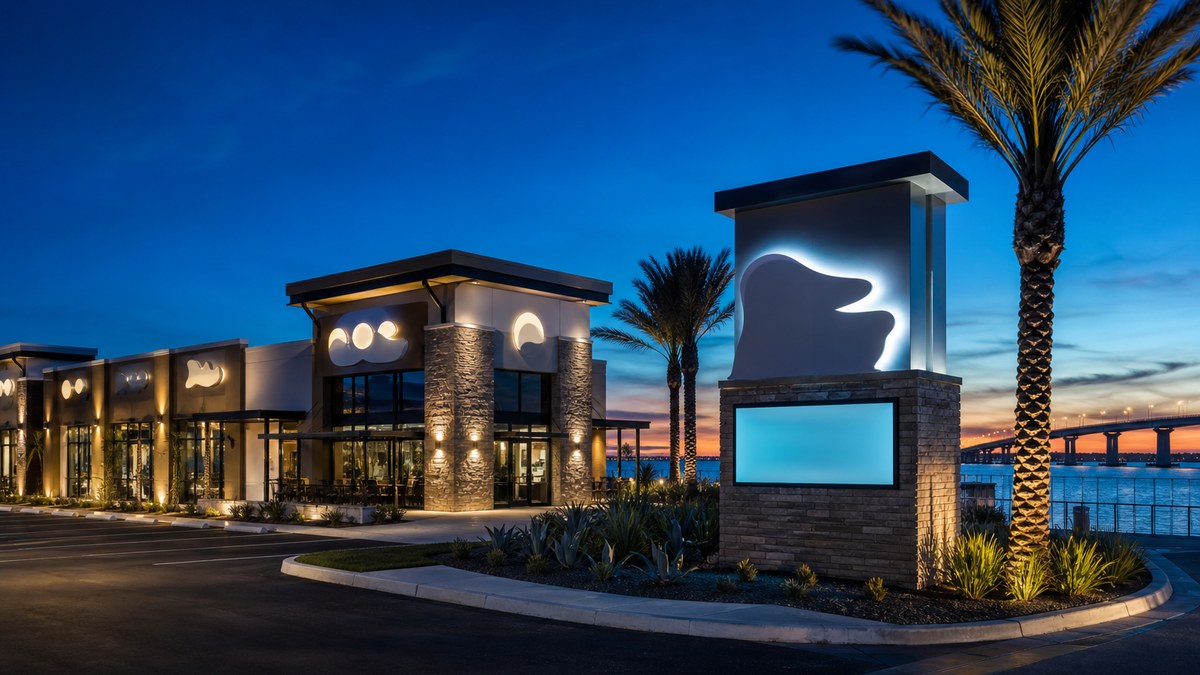
Planning commercial signage in Tampa Bay means working with more than one rulebook. Tampa, St. Petersburg, Clearwater, and unincorporated Hillsborough and Pinellas counties each write their own sign code. A digital sign that one city allows can be banned outright a few miles across the bay. On top of that, every sign has to meet the Florida Building Code and survive a Gulf Coast hurricane season. Our Tampa business signs team builds for all of it.
This guide walks through the Tampa Bay permit process city by city. It covers the LED message center rules that trip up most projects, the state licensing and wind-load requirements, and what the 2024 hurricane season taught the region about building signs that stay up. If you are comparing channel letter signs, monument signs, or a new LED message center for a property anywhere around the bay, start here.
Commercial signs in Tampa Bay need a local sign permit, Florida Building Code wind engineering, and a licensed sign or electrical contractor. The rules change at every city line:
- Tampa: Sign permit through Construction Services (Accela), design wind loads report, electrical + building final inspections
- St. Petersburg: Message centers allowed with limits: 50% of sign area, 32 sq ft max, 1-minute hold, auto-dimming
- Clearwater: Electronic changeable message signs prohibited unless the code specifically allows them
- Unincorporated Pinellas: 1-minute dwell, 5,000 nits day / 350 nits night, 0.3 fc above ambient
- Wind design: Roughly 140–150 mph ultimate design wind speed across most of the bay, confirmed per site
- Codes: 2023 Florida Building Code (8th Ed.) + 2020 NEC today; 9th Edition (2026) takes effect Dec 31, 2026
- Historic areas: Ybor City signs need Barrio Latino Commission approval
Who regulates commercial signs in Tampa Bay?
The first question on any Tampa Bay sign project is not "what sign do I want?" It is "whose code applies?" The answer depends on the parcel, not the mailing address. A Brandon or Riverview address is usually unincorporated Hillsborough County. A Largo or Seminole address can be city or county land depending on the block. Getting this wrong at the start is the single most common reason a sign design has to be redrawn.
Five sets of rules cover most commercial properties around the bay, plus one state layer for highway frontage.
| Jurisdiction | Sign Code | Digital / EMC Stance | Watch For |
|---|---|---|---|
| City of Tampa | Ch. 27, Art. VI, Div. 6 (Secs. 27-289 to 27-289.16) | Allowed by district | Historic districts, downtown digital sign study |
| St. Petersburg | LDR Sec. 16.40.120 | Allowed with limits | 1-minute hold, 32 sq ft cap, monument-style rule |
| Clearwater | CDC Art. 3, Div. 18 | Generally prohibited | Sealed drawings over 32 sq ft, 5 ft setback |
| Unincorporated Hillsborough | LDC Art. VII | Changeable copy OK, no animation | Ground sign height by road type |
| Unincorporated Pinellas | Ch. 138, Art. X | Allowed with limits | 1-minute dwell, nit caps, default-to-black |
| FDOT (state) | F.S. Ch. 479 + FAC 14-10 | 6-second hold | Signs visible from interstates and federal-aid primary roads |
Pull the parcel record from the county property appraiser before you design anything. It tells you the jurisdiction and the zoning district, and those two facts decide the sign size, height, and whether a digital display is allowed at all.
City of Tampa sign permits
Tampa rewrote its entire sign division in 2017 (Ordinance 2017-103). The current rules sit in Chapter 27, Article VI, Division 6. The key sections are 27-289.2 (permits required), 27-289.3 (allowable signs), 27-289.4 (specific sign types, special districts, and alternative sign plans), 27-289.7 (prohibited signs), 27-289.8 (nonconforming signs), and 27-289.15 (billboards).
How the Tampa sign permit works
Sign permits run through the City of Tampa Construction Services Division as a "Commercial Miscellaneous / Signs" permit, applied for in the city's Accela portal. The process moves through application, document review, and then inspections. A typical package includes:
- Site plan with dimensions to the property lines
- Elevations showing the sign on the building or site
- Sign specifications with sign-area calculations
- Design wind loads report for the structure
- Electrical connection information
- Foundation plans for freestanding and building-attached signs
After installation, the sign needs an electrical final and a building final inspection. Missing any document in the package sends it back for revision, and every round trip adds time. That is why we assemble the full set before submitting, including stamped engineering for pylon signs and larger freestanding structures.
Tampa's historic districts and Ybor City
Signs in Tampa's local historic districts need a Certificate of Appropriateness. The Architectural Review Commission covers most districts, and the Barrio Latino Commission covers Ybor City. City staff can approve many routine signs, while others go to a board hearing.
The Ybor City design guidelines are specific. Indirect lighting is encouraged, and small neon or internally lit signs "will be considered." Off-site signs and billboards are not permitted. The guidelines describe wall signs at about 1 square foot per linear foot of frontage with a 75 square foot maximum, window signs at no more than 25% of each panel, and projecting signs up to 25 square feet extending no more than 4 feet. In practice, halo-lit or externally lit letters on a backer are the easiest path through review in a district like Ybor.
In late 2025, Tampa City Council asked the Tampa Downtown Partnership to study large-format digital signs across the Central Business District, including an inventory of existing digital signs. If you are planning a large digital display downtown, expect the rules to be in motion and confirm the current status with the city before design.
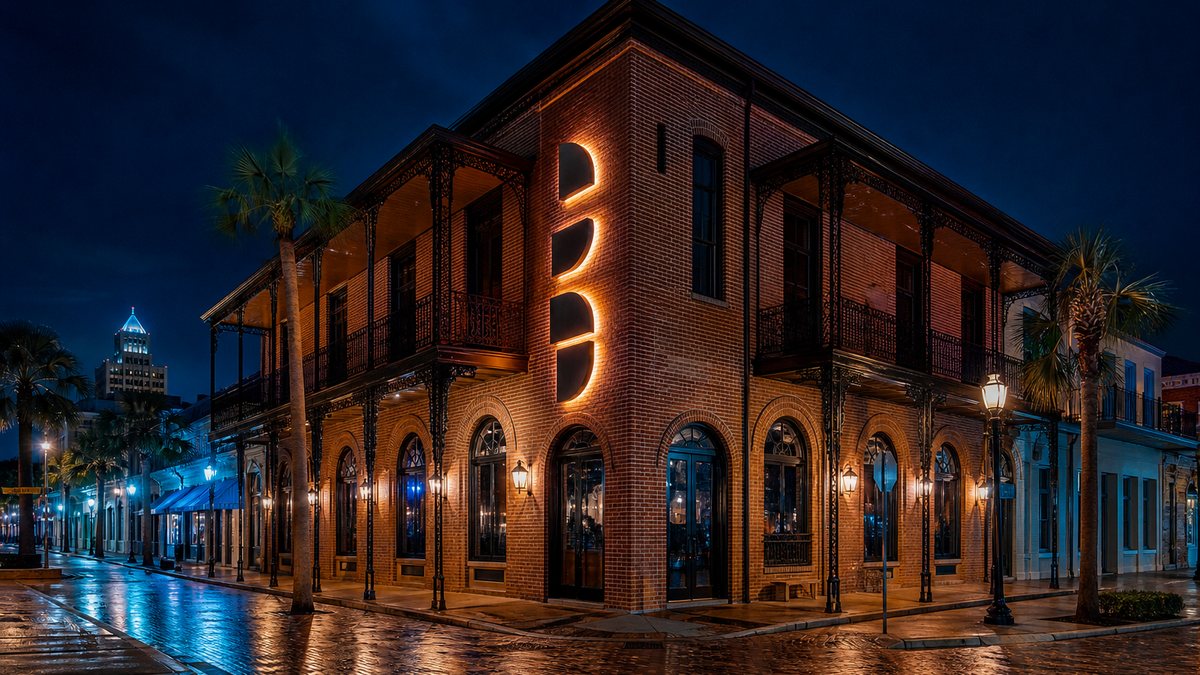
St. Petersburg sign code (LDR 16.40.120)
St. Petersburg is one of the more digital-friendly cities in the region, but the rules are detailed. No sign may be installed without a permit unless it is specifically exempt. Freestanding signs that are 10 feet tall or shorter must be monument style, with a base at least 75% as wide as the sign.
LED message centers in St. Pete
On-premise electronic message centers are allowed in all districts, with conditions:
- The digital area can be no more than 50% of the sign structure and never more than 32 square feet
- Each message must hold for at least 1 minute, with instant changes — no scrolling, flashing, or animation
- Brightness is capped at 0.2 foot-candles, and an automatic light sensor is required
- The display must default to off or full black if it malfunctions
- Message centers may not face one- or two-unit residential property
- In residential districts, messages hold for at least 24 hours, as text on a black background
Freestanding sign limits by district
St. Pete ties freestanding sign size to the zoning district. The busiest commercial corridors allow the largest signs.
| District | Max Area | Max Height |
|---|---|---|
| Downtown Center (DC) | 48 sq ft | 15 ft |
| Corridor Commercial Traditional (CCT) | 64 sq ft | 15 ft |
| Corridor Commercial Suburban (CCS) | Up to 64 sq ft | 20 ft |
| Retail / Employment / Industrial Centers (RC, EC, IC) | Up to 150 sq ft | 20 ft |
| Corridor Residential (CRT, CRS) | 48 sq ft | 10 ft |
Message centers are not allowed on designated local landmarks (with a narrow performing-arts exception). Our St. Petersburg LED signs page covers local project types in more detail.
Clearwater: the strictest code in the bay
Clearwater has a reputation for tight sign rules, and it is earned. Its Community Development Code (Article 3, Division 18) prohibits electronic changeable message signs unless the code specifically allows them elsewhere, and it prohibits portable signs. No sign may be placed, built, altered, or extended without a sign permit.
The city's current sign permit application (revised September 2025) adds several practical requirements:
- Signs over 32 square feet need structural drawings signed and sealed by a Florida-registered engineer or architect
- Freestanding signs must sit at least 5 feet from any property line
- Commercial sign illumination is limited to 5 foot-candles
- Freestanding and monument signs must include a 3 square foot address sign
- Applicants show Building Code and NEC compliance and state whether the sign is UL-listed
Downtown, a freestanding sign is allowed only where the building is set back at least 20 feet, with one sign per parcel and area capped at 64 square feet. A 2024 ordinance also cut the downtown window-sign allowance from 25% to 10%. For most Clearwater businesses, the best result is a well-lit monument sign or crisp wall signs with channel letters rather than a digital display.
Unincorporated Hillsborough, Pinellas & Pasco
Hillsborough County
Outside city limits, Hillsborough's Land Development Code (Article VII) governs. Permits are required, and the county's code sets a 30-day decision window. Animated signs are prohibited, but changeable copy is allowed. Roof, portable, off-premises, tri-vision, and snipe signs are also prohibited. Ground signs can reach 30 feet along expressways and arterials but only 15 feet on collector and local streets. Non-residential ground sign area is generally 1 square foot per linear foot of frontage or 100 square feet, whichever is less, with each face capped at 50 square feet.
Pinellas County
Unincorporated Pinellas (Chapter 138, Article X) requires a zoning clearance and permit. Its message center rules are among the most specific in the region: 5,000 nits by day, 350 nits at night, and no more than 0.3 foot-candles above ambient. Transitions must take 0.5 second or less with no effects, each message must dwell at least 1 minute, message sequencing is not allowed, and the sign must default to black if it fails. Roof, animated, and off-premises signs are prohibited.
Pasco County
Pasco has historically restricted digital signs heavily, with past proposals limited to qualifying regional attractions. If your property is in Pasco, treat a digital display as a "verify first" item before it goes into the design.
Codes are amended often. Always confirm the current text with the permitting office before fabrication. A sign built to last year's rules can still fail this year's review.
LED message center rules side by side
Digital signs cause more Tampa Bay permit problems than any other sign type. The table below compares the core rules. Notice how the hold time ranges from 6 seconds on state highways to a full minute in St. Pete and unincorporated Pinellas. That one number changes how you write your messages, so decide it before you pick a pixel pitch and display size.
| Rule | St. Petersburg | Unincorp. Pinellas | Clearwater | FDOT Highways |
|---|---|---|---|---|
| Allowed? | Yes, with limits | Yes, with limits | Prohibited unless allowed | Permitted outdoor advertising |
| Minimum hold | 1 minute | 1 minute | — | 6 seconds |
| Transitions | Instant, no animation | 0.5 sec or less | — | Whole face at once |
| Brightness | 0.2 fc + auto sensor | 5,000 / 350 nits, 0.3 fc | 5 fc (all lit signs) | No flashing lights |
| Failure mode | Off / black | Black | — | — |
A one-minute hold makes a message center behave more like a changeable menu board than a video screen. That suits schools, churches, medical offices, and retail centers posting a few daily messages. If you need faster rotation, a property inside a more flexible jurisdiction or a static sign with strong illumination may be the better investment.
The Florida state layer: codes, licensing & FDOT
Florida Building Code and NEC
The Florida Building Code 8th Edition (2023) took effect December 31, 2023. It uses ASCE 7-22 for wind loads and adopts the 2020 National Electrical Code. The 9th Edition (2026) is scheduled to take effect December 31, 2026 and moves to the 2023 NEC. Permits submitted around that date may fall under either edition, so ask which one your application will be reviewed against.
Construction documents must state the ultimate design wind speed, risk category, and exposure category. Across most of Tampa Bay, Risk Category II design wind speeds land in roughly the 140–150 mph range, and Pinellas County's local amendment is commonly cited at 145 mph. The exact number is site-specific, which is why your engineer confirms it on every project.
Who can install an electric sign in Florida
Florida law treats sign work as specialty contracting. Under Florida Administrative Code 61G6-7.001, a Sign Specialty Electrical Contractor may handle structural fabrication including concrete foundations, erection, installation, alteration, repair, service, and wiring of electrical signs and outline lighting, but nothing beyond the last disconnect. Work on the building side of that disconnect needs a licensed electrical contractor. Ask any installer for the license that covers the work they will do.
FDOT outdoor advertising (Chapter 479)
Signs within 660 feet of and visible from an interstate or federal-aid primary road, and some State Highway System roads outside urban areas, can need an FDOT permit. State rules set spacing of 1,500 feet on interstates and 1,000 feet on federal-aid primary roads, a 950 square foot size cap, and height limits of 50 feet outside incorporated areas and 65 feet inside. Changeable faces must hold each message at least 6 seconds, change the whole face at once, and avoid flashing or moving lights. These rules mainly affect digital billboards along I-4, I-75, and I-275.
One team for permits, engineering & install
We check the jurisdiction, design to the right code, coordinate Florida-sealed wind engineering, and build signs for Gulf Coast weather. Tell us about your property and we will scope it.
Building hurricane-ready signs for the bay
The 2024 season made the case for engineered signage. Hurricane Helene pushed record storm surge into the bay in late September: the National Weather Service measured peak water levels of 6.83 feet above mean higher high water at Old Port Tampa, 6.67 feet at Clearwater Beach, and 6.31 feet at St. Petersburg. Two weeks later, Hurricane Milton made landfall near Siesta Key as a Category 3 storm. Gusts reached 101 mph at St. Pete's Albert Whitted Airport and 93 mph at Tampa International, with 10 to 20 inches of rain and dozens of tornadoes across the region.
Wind, water, salt, and lightning each attack a sign differently. Here is how to build for all four.
1. Wind: engineered structure, not just a stronger pole
Freestanding signs need foundations designed for the site's wind speed, sign area, height, and soil. Tampa Bay soils are often sandy with a high water table, which affects pier depth and diameter. Our pylon foundation guide explains the math. Faces and retainers matter too: a face that blows out turns the cabinet into a sail and throws debris.
2. Water: assume it gets in, and plan how it gets out
- Clear, correctly placed weep holes in every channel letter and cabinet
- Sealed wire entries with drip loops
- Power supplies, disconnects, and controllers mounted as high as practical in flood-prone areas
- Sealed, gasketed access panels on message center cabinets
3. Salt air: choose materials for the coast
Near the Gulf beaches and bay shoreline, specify stainless or coated hardware, sealed connectors, and marine-grade finishes. Corroded fasteners and anchor bolts are a slow failure you cannot see from the parking lot.
4. Lightning and surges: protect the electronics
Central Florida sees some of the most frequent lightning in the country. Surge protection at the sign, proper grounding, and quality UL-listed power supplies protect message center controllers and LED drivers. The failure patterns look a lot like the ones in our Houston sign repair guide, another Gulf Coast market.
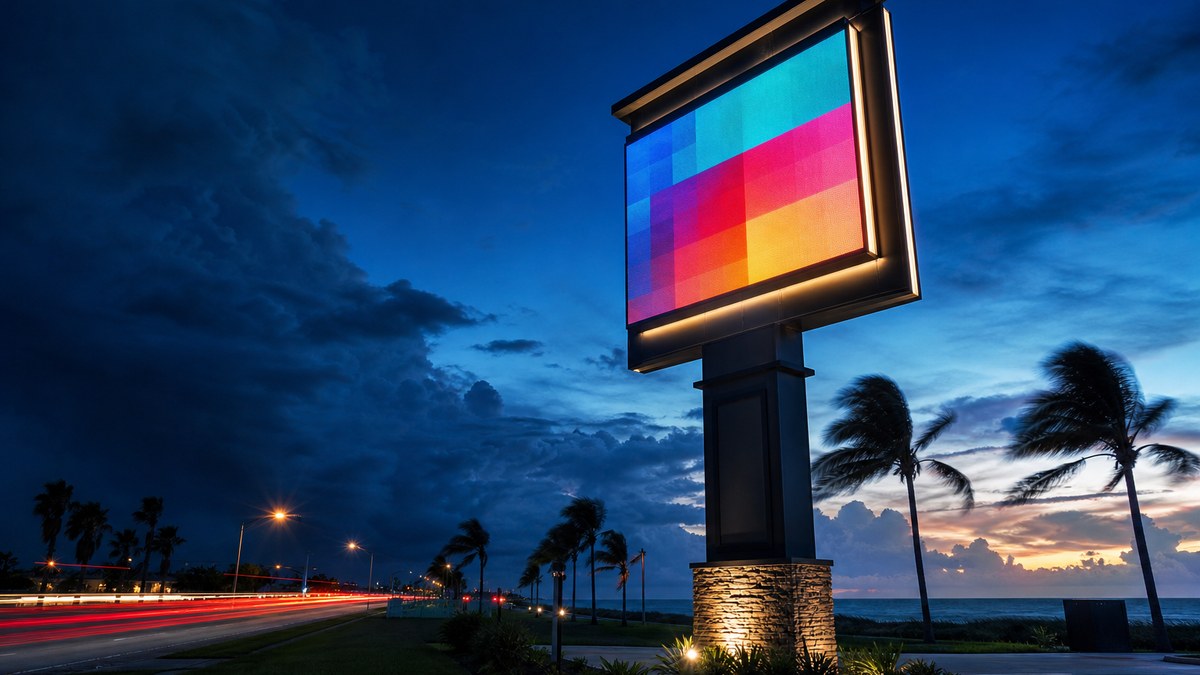
Photograph each sign from all sides, note any loose faces or retainers, and confirm who will inspect after the storm. Those photos speed up insurance claims and make it easier to show what was there if a damaged sign needs to be rebuilt.
After a storm: repair, rebuild, or replace?
Inspect every sign after a major storm, even one that looks fine. Look for cracked or missing faces, water inside letters and cabinets, leaning poles, cracked footings, and any section that will not light. Shut off power to any sign that has standing water inside before anyone opens it. Our sign repair and maintenance crews follow this same order: make it safe, document it, then repair.
Older signs bring a code question. Many signs around the bay were legal when built but no longer meet current size or height rules. Local codes, including Tampa's Sec. 27-289.8, limit how much of a nonconforming sign can be rebuilt. For FDOT-permitted outdoor advertising, a nonconforming sign is considered "destroyed" when more than 60% of its upright supports are damaged, and repairs are capped at 50% of structural materials in any 24-month period. Before you order a rebuild, confirm whether your sign keeps its nonconforming status. Our repair vs replace framework walks through the decision.
A typical Tampa Bay sign project timeline
Every project is different, but most commercial sign jobs around the bay follow the same sequence. These are typical ranges, not guarantees.
- Site survey and jurisdiction check (week 1): parcel, zoning, landlord rules, existing signs, power
- Design and landlord approval (1–2 weeks): sized to the code that actually applies
- Engineering (1–2 weeks): wind load calculations and sealed drawings where required
- Permit review (several weeks): longer with historic review, board hearings, or revisions
- Fabrication (runs during permitting): letters, cabinets, and message center build
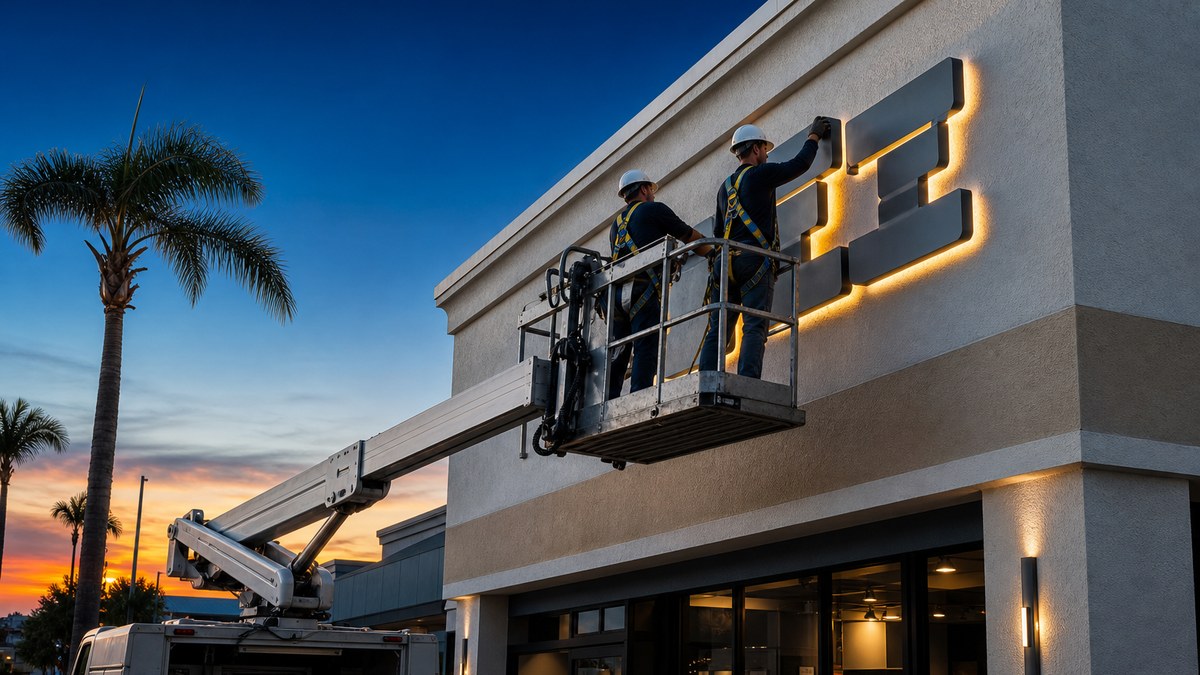
- Installation and inspections (1–3 days on site): then electrical and building finals
The biggest schedule risk is an incomplete permit package or a design that ignores the local code. For more on how timelines vary nationwide, see our sign permit timelines guide, and for the wall-sign build sequence, our channel letter installation guide.
What drives the cost of a Tampa Bay sign
We do not publish prices because materials, engineering, and permit requirements change constantly. Every quote is project-specific. These are the factors that move it:
- Sign type and size: channel letters, lighted box signs, monuments, and pylons differ widely in materials and labor
- Illumination: front-lit, halo-lit, or a full-color message center
- Wind engineering and foundation: taller freestanding signs need deeper, larger foundations
- Jurisdiction: historic review, sealed-drawing thresholds, and board hearings add steps
- Coastal specification: stainless hardware, marine finishes, and surge protection
- Electrical: new circuits, disconnects, and distance to power
- Site access: crane or bucket truck access, traffic control, and working hours
A sign built to the right spec lasts longer and costs less to own. Our true cost of LED sign ownership guide and maintenance guide explain why.
The bottom line
Commercial signage in Tampa Bay succeeds when the project starts with the right jurisdiction, the right message center rules, and the right wind design. Tampa wants a complete package with a wind loads report. St. Petersburg allows digital signs but with one-minute holds and strict brightness limits. Clearwater mostly says no to digital. The counties each add their own twist, and the state layer covers highways, licensing, and the building code.
Build the sign for the Gulf: engineered structure, managed water, coastal-grade materials, and surge protection. Then keep it maintained. We serve the whole region, from Sarasota to Orlando and down to Miami, as part of our nationwide service locations. Browse our project gallery or see all sign services.
Frequently Asked Questions
Do I need a permit for a commercial sign in Tampa?
Yes. The City of Tampa requires a sign permit through the Construction Services Division, filed as a Commercial Miscellaneous / Signs permit in the Accela portal. The package typically includes a site plan, elevations, sign specifications with area calculations, a design wind loads report, electrical information, and foundation plans for freestanding signs. The sign then needs electrical and building final inspections.
Are LED message center signs allowed in St. Petersburg, FL?
Yes, with limits. St. Petersburg allows on-premise electronic message centers in all districts if the digital area is no more than 50% of the sign and no more than 32 square feet. Messages must hold at least one minute with instant changes, brightness is capped at 0.2 foot-candles with an automatic light sensor, and the sign must go dark if it malfunctions. They cannot face one- or two-unit residential property.
Can I install a digital sign in Clearwater?
Usually not. Clearwater's Community Development Code prohibits electronic changeable message signs unless the code specifically allows them. Most Clearwater businesses use illuminated monument signs or channel letter wall signs instead. Confirm with the city's planning department before designing any digital display.
What wind speed do Tampa Bay signs have to be designed for?
Signs are designed under the Florida Building Code using ASCE 7. Across most of Tampa Bay, Risk Category II ultimate design wind speeds fall in roughly the 140 to 150 mph range, and Pinellas County's figure is commonly cited at 145 mph. The exact value depends on the site, so a Florida-licensed engineer confirms it on the construction documents.
Who is allowed to install an illuminated sign in Florida?
Florida treats sign work as specialty contracting. A Sign Specialty Electrical Contractor can fabricate, erect, install, repair, and wire electrical signs, including concrete foundations, but cannot work beyond the last disconnect. Work on the building's electrical system past that point needs a licensed electrical contractor. Always ask your installer which license covers the job.
Which building code applies to signs in Florida right now?
The Florida Building Code 8th Edition (2023), which took effect December 31, 2023, applies today along with the 2020 National Electrical Code. The 9th Edition (2026) is scheduled to take effect December 31, 2026 and moves to the 2023 NEC. Ask the permitting office which edition your application will be reviewed under if you submit near that date.
Do signs in Ybor City need special approval?
Yes. All signs in Ybor City must be approved by the Barrio Latino Commission through a Certificate of Appropriateness. The design guidelines encourage indirect lighting, will consider small neon or internally lit signs, do not permit billboards or off-site signs, and limit wall, window, and projecting sign sizes. Halo-lit or externally lit letters are usually the easiest path through review.
How long does a commercial sign project take in Tampa Bay?
Most projects move through survey, design, engineering, permitting, fabrication, and installation. Design and engineering often take two to four weeks combined, and permit review takes several weeks, longer when historic review or revisions are needed. Fabrication runs during permitting, and installation usually takes one to three days on site. These are typical ranges, not guarantees.
How do I make my business sign hurricane-ready?
Start with an engineered structure and foundation designed for the site's wind speed. Use impact-resistant faces and secure retainers, keep weep holes clear, seal wire entries, mount power supplies and controllers high in flood-prone areas, choose stainless or coated hardware near salt water, and add surge protection. Photograph the sign before each storm and inspect it after.
How much does a commercial LED sign cost in Tampa Bay?
Costs depend on sign type and size, illumination, wind engineering and foundation, the jurisdiction's review steps, coastal materials, electrical work, and site access. Because these factors and material costs change constantly, every project is quoted individually. Request a free quote with your address and sign goals for a project-specific estimate.
Ready to plan your Tampa Bay sign?
From Ybor City storefronts to Pinellas message centers and I-275 pylons, we handle the code research, sealed engineering, permits, and installation. Send us your address and goals.
American LED Signage is part of a network of commercial lighting and signage specialists. For projects beyond signage, see our partner sites: Dallas commercial LED, Fort Worth LED lighting, Arlington LED specialists, Plano commercial LED, Irving LED installations, statewide Texas LED lighting, wholesale LED components, American Starlight Ceilings for premium interior fiber optic ceilings, fiber optic lighting systems, modular building solutions, and modular structures in Dallas.