LED Billboards: Sizes, Permits, Spacing & Brightness Rules for Digital Billboards
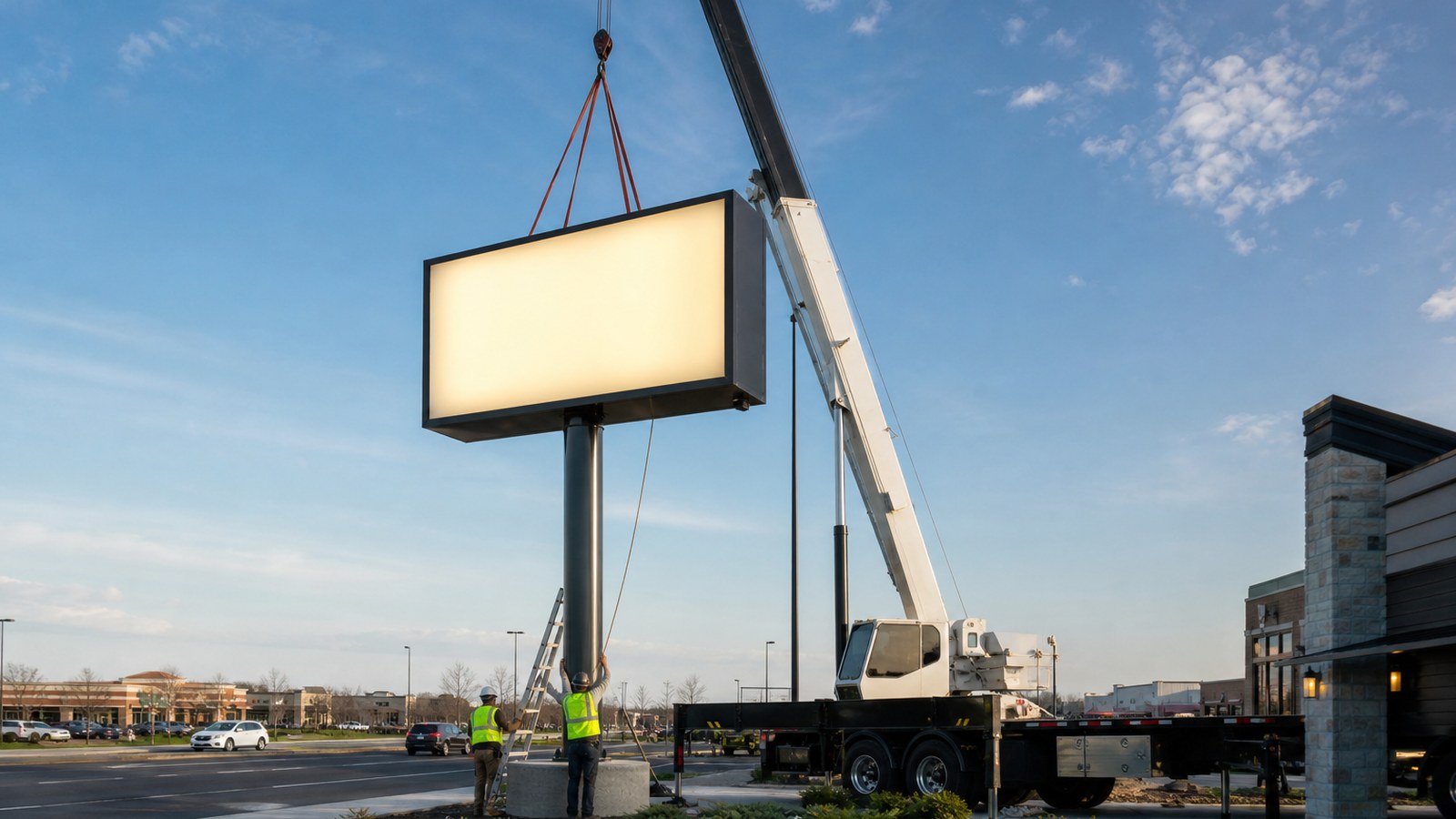
LED billboards are the most regulated signs on the American roadside. Before a single module lights up, a digital billboard has to clear federal highway rules, a state outdoor advertising permit, local zoning, structural engineering and an electrical inspection — and then it has to follow operating rules on message hold times, transitions and brightness for as long as it stands.
This guide explains how digital billboards actually get approved and built in the United States: the standard billboard sizes, which agency controls what, the spacing and brightness rules most states use, what changes when you convert a static board to LED, and the engineering behind a highway-scale structure. We also cover the markets where we see the most billboard questions right now — Texas, Oklahoma, Arizona, Oregon and Alaska.
One note before we start: this is a guide for property owners, outdoor advertising operators and businesses planning a structure. Rules change and every site is different, so treat the numbers here as a starting point and confirm them with the state DOT and the city before you sign a lease or order a display.
An LED billboard is legal only where the state DOT, the local zoning code and the structure all say yes. The rules that decide most projects:
- Standard sizes: 14×48 ft bulletin is the highway standard; 10′6″×36 ft, 12×24 ft and 20×60 ft formats are also common
- Federal control zone: signs within 660 ft of an Interstate or federal-aid primary highway need a state outdoor advertising permit
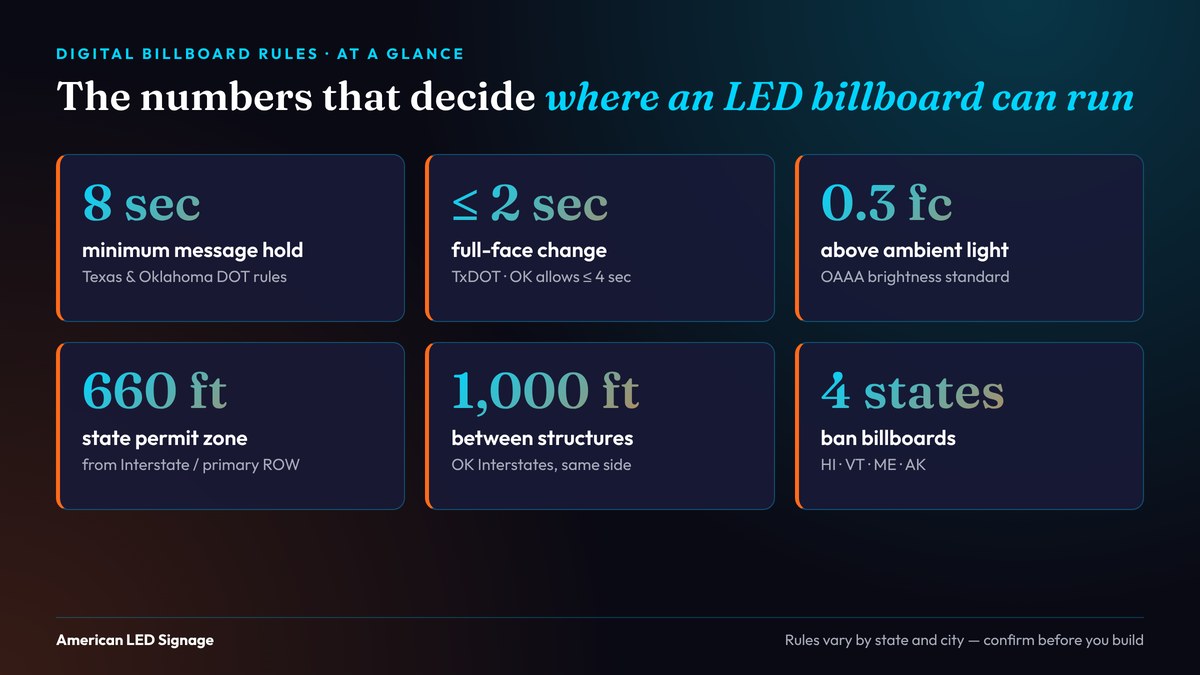
- Message hold: 8 seconds minimum in states like Texas and Oklahoma; FHWA guidance cites 4–10 seconds
- Transitions: Texas requires a full-face change within 2 seconds; Oklahoma allows 4 seconds or less and bans scrolling or fading
- Brightness: industry standard is no more than 0.3 foot-candles above ambient, measured at 250 ft for a 14×48 face, with automatic dimming
- Spacing: Oklahoma, for example, requires 1,000 ft between sign structures on the same side of an Interstate
- Banned outright: Vermont, Maine, Hawaii and Alaska prohibit billboards, and 700+ U.S. communities restrict or ban them
What counts as an LED billboard?
The word “billboard” gets used loosely, but sign codes draw a hard line between two kinds of signs. Getting this right is the first step, because it decides which rulebook applies.
Off-premise signs (true billboards)
An off-premise sign advertises a business, product or message that is not sold or located on the property where the sign stands. A 14×48 digital face along the interstate that rotates ads for a dozen advertisers is the classic example. Off-premise signs are what the Highway Beautification Act, state outdoor advertising programs and most local billboard bans are written to control.
On-premise signs (your own sign)
An on-premise sign identifies or advertises the business on the same property. A pylon sign with an LED message center in front of a car dealership, a church monument sign or a shopping-center tenant panel are on-premise signs, even when the LED display is very large. These signs are mainly governed by the local sign code, although many states still apply hold-time and brightness rules to them near highways.
Why it matters: a business that wants a large digital sign on its own lot often has a much easier path than an operator selling ad space. If you mostly want to promote your own business, read our programmable LED sign buyer’s guide first — an on-premise message center may get you most of the visibility with far fewer approvals.
Some codes treat a sign as off-premise the moment it shows any paid third-party advertising, even for a few seconds of a rotation. If you plan to rent time on an on-premise display, ask the city how that changes the sign’s classification before you build.
Standard billboard sizes and pixel pitch
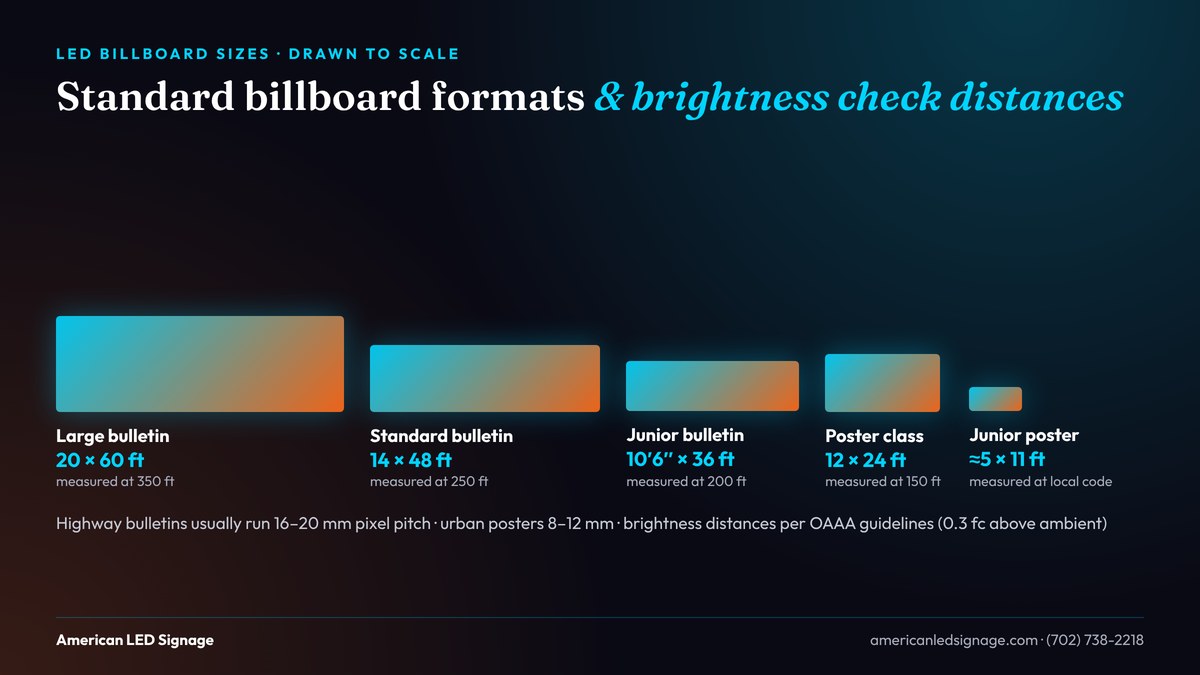
Outdoor advertising uses a small set of standard formats so that operators, advertisers and sign builders can plan around the same dimensions. Digital faces generally follow the same sizes as printed boards. The brightness measurement distances in the last column come from the Out of Home Advertising Association of America (OAAA) brightness guidelines and roughly reflect how far away drivers usually read each format.
| Format | Face Size (H × W) | Typical Location | OAAA Measuring Distance |
|---|---|---|---|
| Large bulletin | 20 × 60 ft | Major interstates, urban freeways | 350 ft |
| Standard bulletin | 14 × 48 ft | Interstates and primary highways (the default) | 250 ft |
| Junior bulletin | 10′6″ × 36 ft | Highways and busy arterials | 200 ft |
| Poster (30-sheet class) | 12 × 24 ft class | Arterial roads, suburban corridors | 150 ft |
| Junior poster (8-sheet class) | about 5 × 11 ft | City streets, neighborhoods | Local code |
Which pixel pitch fits each size?
Pixel pitch is the distance between LED pixels, measured in millimeters. Highway bulletins are read from long distances at high speed, so they typically use a coarser 16–20 mm pitch. Urban digital displays and posters viewed from closer range usually use 8–12 mm. Finer pitch is not automatically better for a billboard: it adds modules, weight, power and heat without making the message any easier to read at 60 mph. A simple rule of thumb from our message center guide still works — the minimum comfortable viewing distance in feet is roughly 3 times the pitch in millimeters, and the best pitch is the one that matches the real viewing distance.
Single, back-to-back or V-build?
Most highway structures carry two faces. A back-to-back build puts the faces parallel on the same frame, while a V-build angles them apart so each face points at oncoming traffic in one direction. State rules often limit how far apart the faces may be — Oklahoma, for example, says V-type faces may not exceed 30 feet between faces at the widest point — and tri-face signs are prohibited there.
Who approves an LED billboard: the three layers
Every digital billboard sits under three overlapping layers of control. A project has to pass all three, and the strictest rule wins.
1. Federal: the Highway Beautification Act
The Highway Beautification Act of 1965 (23 U.S.C. 131) ties federal highway funding to how each state controls outdoor advertising along the Interstate and federal-aid primary system. In practice, this is why states regulate signs within 660 feet of the right-of-way of those highways, and why billboards there are generally allowed only in commercial or industrial zones or unzoned commercial areas. Each state has a federal-state agreement that sets its size, lighting and spacing rules.
In 2007 the Federal Highway Administration issued guidance saying changeable message (digital) off-premise signs can be acceptable where the state’s agreement allows them, and recommended limits such as a message duration of roughly 4 to 10 seconds, quick transitions, no flashing, animation or video, and automatic brightness adjustment. States then wrote their own specific rules.
2. State: the DOT outdoor advertising permit
The state department of transportation issues the outdoor advertising permit and enforces spacing, size and digital operating rules on regulated highways. Many states also license outdoor advertising businesses separately from the sign permit. In Oklahoma, any sign within 660 feet of the right-of-way and visible from an Interstate or federal-aid primary must be registered and permitted by ODOT’s Outdoor Advertising Control Branch, and upgrading an existing registered sign to LED requires that branch’s prior written approval.
3. Local: zoning, building and electrical permits
The city or county decides whether an off-premise sign is allowed at all, in which zones, and how big and tall it can be. Then the building department reviews the structure and foundation, and an electrical permit covers the power. Local control is where most billboard projects stop: according to Scenic America, more than 700 U.S. communities prohibit billboards, including major cities such as Houston and Los Angeles. Houston has allowed no new off-premise billboards since 1980, which we cover in our Houston LED sign installation guide.
Four states ban billboards statewide: Hawaii (1927), Vermont (1968), Maine (1977) and Alaska (1998). The bans cover digital billboards too. On-premise business signs, including LED message centers, are still allowed under local sign codes in those states.
Digital billboard operating rules: hold time, transitions & effects
Once a digital face is approved, the state and city rules control how it runs. These rules exist because a sign that changes too fast or too brightly pulls drivers’ eyes off the road. The most common requirements are similar from state to state, but the exact numbers differ.
| Jurisdiction | Minimum Hold | Transition | Other Key Rules |
|---|---|---|---|
| FHWA 2007 guidance | 4–10 sec | Quick, no effects | No flashing, animation or video; automatic brightness adjustment |
| Texas (TxDOT, 43 TAC §21.196) | 8 sec | Within 2 sec, whole face at once | Auto-dimming; freezes on malfunction; must run emergency information such as Amber Alerts |
| Oklahoma (ODOT, OAC 730:35-5-12) | 8 sec | 4 sec or less | No scrolling or fading; prior written approval to convert to LED |
| Arkansas (ArDOT) | 8 sec | 2 sec | Spacing between digital signs on Interstates |
| Indiana (INDOT) | 8 sec | 2 sec | 0.3 fc above ambient brightness limit |
| Florida (FDOT) | 6 sec | Per FDOT rule | Separate spacing and size limits under state law |
Local codes are often stricter than the state. Cities commonly add longer hold times, curfews near homes, distance buffers from residential zones and signalized intersections, and caps on the number of digital faces. We break down several of those city rules in our guides to Indianapolis, Arkansas and Tampa Bay.
Controller features that keep you compliant
- Hold-time locks in the content software so no one can schedule a 5-second spot on an 8-second board
- Hard cuts only — disable scrolling, fades, wipes and video where the code bans them
- Fail-safe mode that freezes or blanks the display if the controller or data link fails
- Emergency message access for Amber Alerts and public-safety messages where the state requires it
- Logs and remote monitoring so you can prove what ran and when if a complaint comes in
LED billboard brightness rules
Brightness is the rule that generates the most complaints from neighbors and the most enforcement calls. LED billboard faces are built to be readable in direct midday sun, which takes very high output. At night that same output would be blinding, so the sign has to dim automatically.
The most widely used standard comes from the OAAA: light from a digital billboard should not exceed 0.3 foot-candles over ambient light levels. It is measured with a foot-candle meter, perpendicular to the face, at a set distance for each size — 150 feet for a 12×24 face, 200 feet for 10′6″×36, 250 feet for 14×48 and 350 feet for 20×60. The guidelines also say digital billboards should have automatic dimming, and that sunset-sunrise tables or manual control are not acceptable as the primary way to control brightness.
Many states and cities have adopted the 0.3 foot-candle method, while others set maximum nit levels for day and night instead. Either way, plan for a light sensor (photocell) on every face, a dimming curve that is tested at commissioning, and a measurement report if your permit requires one.
Set the night brightness during commissioning with a meter on site, not from the factory default. Factory curves are written for a generic location. A board facing a dark rural highway needs a much lower night level than one surrounded by lit car lots.
Spacing, size and location limits
Spacing rules keep billboards from stacking up along one stretch of highway. They are measured along the road, usually on the same side, and they often differ for Interstates and freeways versus other primary highways. Oklahoma’s rules are a good example of how a typical state sets them up:
| Oklahoma Rule (ODOT) | Requirement |
|---|---|
| Interstates and controlled-access highways | 1,000 ft apart, same side |
| Non-controlled primary highways inside cities | 300 ft same side / 100 ft opposite side |
| Outside cities, near interchanges and rest areas | Not within 500 ft |
| Near parks, forests, playgrounds, cemeteries | Not within 500 ft |
| Maximum face area | 1,200 sq ft per facing |
| Maximum face dimensions | 25 ft high × 60 ft long |
On top of state spacing, many states and cities add a separate, larger spacing between digital faces facing the same direction. Local codes may also set maximum structure height, minimum setbacks from property lines and right-of-way, and buffers from homes. Run every one of these against the actual site before you commit to a lease — one existing digital board down the road can make a parcel unusable.
Find out if your site can carry an LED billboard
We review zoning, state DOT spacing, structure and power for your parcel or existing board, then quote the engineering, display and installation — with UL-listed components and multi-year warranties.
Converting a static billboard to LED
Most new digital faces in the U.S. are conversions of existing static boards, not brand-new structures. A conversion can be the fastest path to a digital face, but it is not automatic.
Check the sign’s legal status
Many older billboards are legal nonconforming signs — they were legal when built but would not be allowed today. Codes usually limit what you can do to a nonconforming sign. Converting it to digital is often treated as a change that the code does not allow, or that requires a special permit. Some cities only allow a digital conversion if the owner removes other static faces elsewhere in the city in exchange.
Get state approval first
On regulated highways, the state usually has to approve the change. Oklahoma requires prior written approval from ODOT’s Outdoor Advertising Control Branch before an existing registered sign is upgraded to LED or tri-vision. Expect the state to confirm that the location still meets spacing for digital signs.
Re-check the structure
An LED cabinet is much heavier than a vinyl face on a catwalk frame, and it adds cooling equipment, power supplies and controllers. The face area may stay the same, but the dead load and the load path change. A licensed engineer should review the existing pole, connections, base plate, anchor bolts and foundation, and many building departments require sealed calculations before they issue the conversion permit. Corrosion at the base plate and anchor bolts is a common finding on older structures.
Bring in power and data
A static board may only have a small lighting circuit. A digital face needs a properly sized electrical service, a disconnect, grounding and surge protection installed by a licensed electrician under NEC Article 600, plus a reliable data connection (usually cellular or fiber) for content and monitoring.
Engineering a highway-scale LED billboard
A new 14×48 digital structure is one of the largest freestanding signs a crew will ever build. The engineering follows the same principles as our pylon sign foundation guide, scaled up.
Foundation and pole
Highway billboards usually stand on a single large steel monopole set in a drilled caisson foundation, often 15 to 30+ feet deep depending on soil, height and wind. A geotechnical soil report comes first. Concrete typically reaches design strength at 28 days, and the structure is not loaded until test cylinders confirm the specified strength.
Wind and seismic design
Most U.S. markets design for roughly 115 to 130 mph wind, while hurricane coasts run 140 to 180 mph. A 14×48 face is a sail more than 670 square feet in area, mounted high above the ground, so the base moment is enormous. Seismic regions add detailing for the pole-to-foundation connection.
Cabinet, cooling and service access
- Front or rear service: rear-service cabinets use a walk-in catwalk; front-service designs let technicians swap modules from a lift
- Weather sealing: sealed module faces, gasketed doors and drainage to keep water out of the electronics
- Thermal management: ventilation or air-conditioning sized for full summer sun on a dark cabinet
- Redundancy: redundant power supplies and data paths so one failure does not black out the face
- Surge and lightning protection: a tall steel pole in an open field is a lightning target
- UL-listed components: listed displays, power supplies and controls, inspected under NEC Article 600
Ongoing maintenance
LED billboards run up to 24 hours a day, 365 days a year. Plan for remote monitoring, a stock of spare modules from the same production batch so colors match, and scheduled inspections of the structure, catwalks, cabinet seals and power supplies. Our commercial LED sign maintenance guide and sign repair and maintenance service cover the routine.
LED billboards in the markets people are asking about
Billboard rules are local, so here is how the state layer sets up in the places our clients ask about most. Always confirm the city’s own code as well.
Texas: College Station, Killeen, Abilene and DFW
On regulated highways, TxDOT’s electronic sign rule requires each message to display for at least 8 seconds, a full-face change within 2 seconds, automatic dimming, a default that freezes the sign if it malfunctions, and coordination to display emergency information such as Amber Alerts. Cities then layer on their own zoning, and some Texas cities restrict or prohibit new off-premise signs entirely. If you are planning a board near Texas A&M or along I-14 or I-20, see our College Station, Killeen and Abilene pages, and our Dallas and Houston teams for the big metros.
Oklahoma: Oklahoma City, Midwest City, Tulsa and Catoosa
ODOT registers and permits every sign within 660 feet of a regulated highway that is visible from it. Signs on Interstates need 1,000 feet of same-side spacing, faces are capped at 1,200 square feet and 25 by 60 feet, and changeable faces may rotate no more often than every 8 seconds with a change of 4 seconds or less — no scrolling or fading. Converting a registered sign to LED needs ODOT’s written approval first. City zoning in Oklahoma City, Midwest City, Tulsa and Catoosa decides where off-premise signs can go at all.
Arizona: Gilbert and Chandler
In the East Valley, the city sign code is usually the deciding factor, and suburban codes tend to limit new off-premise signs and digital displays far more than the state does. For many businesses here, a large on-premise LED message center on a pylon or monument is the practical way to get digital visibility. See our Gilbert and Chandler pages, and plan for desert heat in the cabinet cooling design.
Oregon: Beaverton and Portland
Oregon controls outdoor advertising along state highways through ODOT, and Portland-area cities add strict local limits on digital displays. Our Portland digital signs guide shows how tight those limits can be, and our Beaverton page covers the west-side suburbs.
Alaska: Anchorage
Alaska banned billboards statewide in 1998, so an off-premise LED billboard is not an option in Anchorage. Businesses can still use on-premise signs, including LED message centers, under local sign rules — built for cold starts, snow load and long winter nights.
LED billboard project timeline
Every project is different, but the sequence is predictable. Permits and approvals take far longer than building the sign, which is why our sign permit timelines guide is worth reading before you set a launch date.
- Feasibility (2–6 weeks): zoning check, state spacing survey, existing-sign inventory, power and data availability, landlord or lease terms.
- State permit: DOT outdoor advertising application and any digital conversion approval. Timing varies widely by state.
- Local approvals: zoning approval or special use permit, then building and electrical permits with sealed structural drawings.
- Engineering and soil report (1–3 weeks): geotechnical report, foundation and structure design, wind and seismic calculations.
- Fabrication: display cabinets, steel and controls are built while permits finish, so they are ready when the foundation is.
- Foundation (about 4 weeks): drilling, rebar cage and anchor bolts, pour, then curing to the specified strength.
- Installation and commissioning (days): pole and cabinet set by crane, power and data connected, brightness and hold-time settings tested, final inspections.
What drives the cost of an LED billboard
We do not publish prices because they change constantly with display supply, steel and site conditions. What we can tell you is what moves a quote up or down:
- Face size and number of faces: a single 10′6″×36 face versus a two-sided 14×48 V-build
- Pixel pitch and brightness: finer pitch means more LEDs, more power supplies and more weight
- New structure versus conversion: a sound existing pole saves the foundation; a weak one may need reinforcing or replacement
- Soil, wind and seismic zone: these set the caisson depth and steel size
- Electrical service: distance to utility power, transformer needs and trenching
- Site access: crane setup, traffic control and right-of-way work
- Approvals: engineering stamps, soil reports, special permits and any required static-face removals
- Service plan: remote monitoring, spare modules and maintenance terms
For the long-term view — energy, maintenance and end-of-life over 15+ years — see our true cost of LED sign ownership breakdown. Then request a free quote for numbers specific to your site.
Frequently Asked Questions
What is the standard size of an LED billboard?
The standard highway billboard, called a bulletin, is 14 feet high by 48 feet wide, and most digital highway faces use that size. Other common formats are the 20 by 60 foot large bulletin, the 10 foot 6 inch by 36 foot junior bulletin, the 12 by 24 foot class poster used on arterial roads, and smaller junior posters of about 5 by 11 feet on city streets.
Do I need a permit for an LED billboard?
Yes. An off-premise LED billboard usually needs a state DOT outdoor advertising permit if it is within 660 feet of an Interstate or federal-aid primary highway, plus local zoning approval and building and electrical permits. Converting an existing static board to digital often needs its own approvals, and in some states, such as Oklahoma, the DOT must approve the LED upgrade in writing first.
How long must each message stay on a digital billboard?
Many states require at least 8 seconds per message, including Texas, Oklahoma, Arkansas and Indiana. Florida uses a 6-second minimum on state-regulated highways. Federal Highway Administration guidance from 2007 cites a range of about 4 to 10 seconds. Cities can require longer holds, so check the local sign code too.
How bright can an LED billboard be?
The most common standard says a digital billboard should not exceed 0.3 foot-candles above ambient light, measured perpendicular to the face at 250 feet for a 14 by 48 foot board, 200 feet for a 10 foot 6 inch by 36 foot board, 150 feet for a 12 by 24 foot board and 350 feet for a 20 by 60 foot board. The sign should dim automatically with a light sensor rather than a sunset timer.
How far apart do billboards have to be?
It depends on the state and the road. Oklahoma, for example, requires 1,000 feet between sign structures on the same side of an Interstate or controlled-access highway, 300 feet on the same side of other primary highways inside cities, and keeps signs 500 feet from interchanges outside cities. Many states and cities add a larger spacing between digital faces, so confirm both state and local rules.
Which states do not allow billboards?
Hawaii, Vermont, Maine and Alaska ban billboards statewide, and the bans include digital billboards. In addition, more than 700 U.S. communities prohibit or restrict billboards locally, including large cities such as Houston and Los Angeles. On-premise business signs, including LED message centers, are generally still allowed under local sign codes.
Can I convert my static billboard to a digital billboard?
Sometimes. You need the state to approve the change on regulated highways, the city to allow digital conversion in that zone, and an engineer to confirm the existing structure and foundation can carry the heavier LED cabinet. Legal nonconforming signs are often limited or barred from digital conversion, and some cities only allow it if other static faces are removed.
What pixel pitch is best for a highway LED billboard?
Highway bulletins viewed from long distances at high speed typically use a 16 to 20 mm pixel pitch. Urban digital displays and posters viewed from closer range usually use 8 to 12 mm. A rough rule is that the minimum comfortable viewing distance in feet is about 3 times the pitch in millimeters, so match the pitch to the real viewing distance rather than choosing the finest pitch available.
Can digital billboards show video or animation?
Usually not on highways. Federal guidance recommends against flashing, intermittent or moving light, animation and video on off-premise digital signs, and states such as Texas require the whole face to change at once within 2 seconds. Oklahoma prohibits scrolling or fading between messages. Each message must be a still image held for the minimum time.
What affects the cost of an LED billboard?
Cost depends on face size and number of faces, pixel pitch, whether you build a new structure or convert an existing one, soil and wind conditions that set the foundation size, electrical service, crane and site access, engineering and permit requirements, and the maintenance plan. Prices change often, so request a free site-specific quote from American LED Signage at (702) 738-2218.
From feasibility study to lights-on
Zoning and DOT research, engineer-sealed structures, UL-listed LED displays, compliant hold-time and dimming settings, installation and ongoing service — one team, nationwide.
American LED Signage is part of a network of commercial lighting and signage specialists. For projects beyond signage, see our partner sites: Dallas commercial LED, Fort Worth LED lighting, Arlington LED specialists, Plano commercial LED, Irving LED installations, statewide Texas LED lighting, wholesale LED components, American Starlight Ceilings for premium interior fiber optic ceilings, fiber optic lighting systems, modular building solutions, and modular structures in Dallas.