Digital Signs in Portland, OR: Title 32 Rules, Permits & Monument and Letter Sign Guide
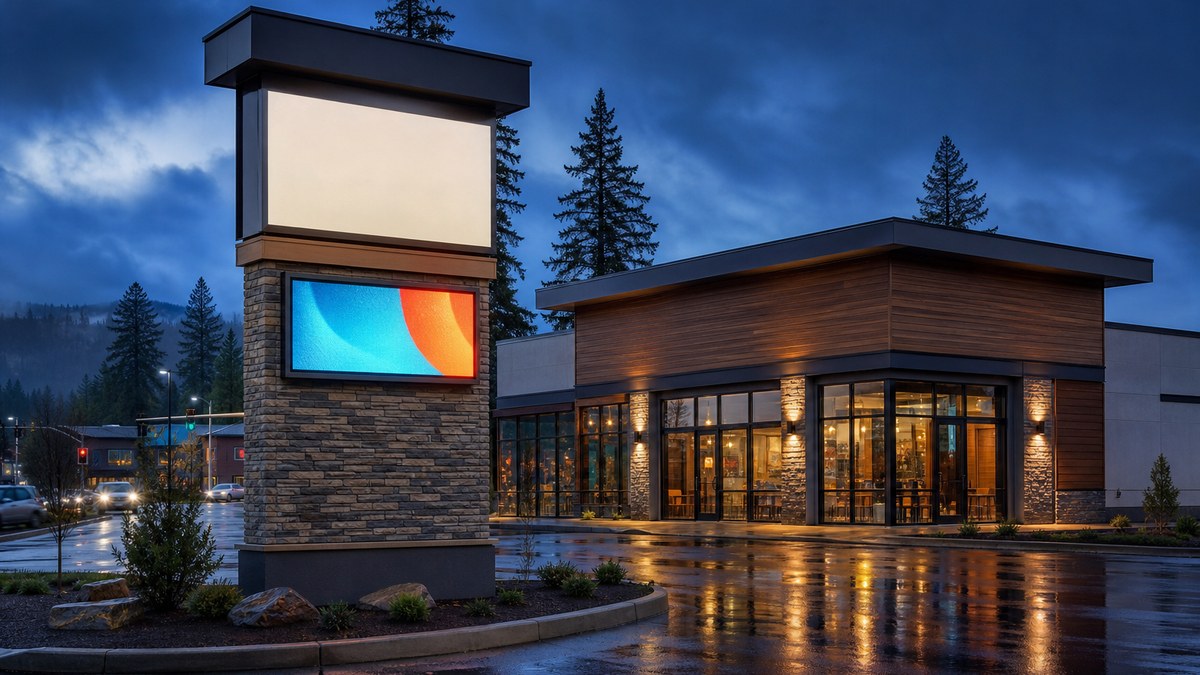
Planning digital signs in Portland, OR starts with one fact most out-of-town sign shops miss: Portland is one of the most restrictive big cities in the country for electronic displays. The city's sign code, Title 32, caps the changing-image area on most commercial sites at 20 square feet in total. That single rule shapes every decision about LED message centers, monument signs, and illuminated letters you put on a Portland building.
The good news: Portland still gives businesses generous room for static illuminated signage. Wall signs, channel letters, blade signs, and monument signs can be large, bright, and memorable when they are designed around the code from day one. The trick is knowing which zone your property sits in, which overlays apply, and what the permit reviewers will ask to see.
This guide walks through Portland's sign rules in plain English: how much sign area you get, where digital displays are allowed, how the permit process runs through Portland Permitting & Development, which licenses the installer needs, and how Pacific Northwest rain, ice, and wind change the build. For a city overview, see our Portland business signs page.
Digital signs are allowed in most Portland commercial, employment, and industrial zones, but Title 32 strictly limits their size, and nearly every permanent sign needs a city permit plus engineering and electrical review.
- 20 sq ft per site: the combined changing-image (digital) area allowed on most commercial sites (Title 32, 32.32.030 D).
- 10 sq ft per sign: the most changing-image area one sign can have, unless the digital part covers less than 60% of that sign face.
- Banned zones: digital features are prohibited in residential zones and in the CM1, CI1, and RX zones (sports fields excepted).
- Wall sign allowance: 1.5 sq ft per linear foot of primary building wall, or 1 sq ft per foot when the site also has a freestanding sign.
- Freestanding height: 15, 20, or 25 ft maximum depending on the zone, including the structure.
- Engineering: freestanding, channel letter, projecting, and canopy signs need calculations by an Oregon-licensed engineer.
- Electrical: internally illuminated signs need a separate electrical permit and an Oregon-licensed sign electrician.
Why Portland's sign code is different
Most Sun Belt cities treat electronic message centers as a normal part of a commercial sign package. Portland does not. The city has long favored a pedestrian-scaled, low-glare streetscape, and Title 32 reflects that. Static signs are regulated by size, height, and placement. Signs that move, flash, scroll, or change automatically are regulated much more tightly.
Portland defines a changing image sign broadly. Any sign that moves, flashes, sequences lights, or changes its image automatically counts. A static sign whose lighting simply switches on and off no more than once every 24 hours does not. Projected images and holograms are treated as signs, too. If you want a scrolling price board, a full-color video display, or even a simple time-and-temperature unit, you are in changing-image territory.
That is why the most successful Portland storefronts lean on beautifully lit static signage, such as channel letters, halo-lit logos, and projecting blade signs, and use a small, well-placed digital panel only where it really earns its space.
Look up your zone before you design anything. Portland's online zoning map shows your base zone (CM2, CE, EX, IG, and so on) and any overlays or plan districts. The zone decides your digital allowance, your freestanding sign height, and your maximum sign size.
Digital and LED message center rules in Portland
Section 32.32.030 D of the Portland City Code sets the core rules for changing-image features. Here is what they mean in practice for a business that wants an LED message center.
Where digital signs are allowed
Changing-image features are allowed in the CE, CI2, CM2, CM3, CX, EG, EX, IG, and IH zones, subject to the size limits below. They are prohibited in the RX, CI1, and CM1 zones, except for signs in or facing a sports field, and they are prohibited in residential and open-space zones. Some plan districts go further. In the Macadam plan district, for example, changing-image features are not allowed at all.
How big a digital display can be
This is the rule that surprises most national brands. Changing-image features are limited to a combined total of 20 square feet per site. No single sign may have more than 10 square feet of changing-image area unless those features cover less than 60% of that sign's face. Every digital area on the site counts toward the 20-square-foot total, and the code does not let you double the allowance by using both sides of a back-to-back sign.
For reference, a 20-square-foot display is roughly 2.5 by 8 feet. That is a useful size for a gas station price board, a pharmacy message line, or a short event message on a school or church monument. It is not a billboard-style video wall, and you should not plan one.
Freeways and bridges
Location matters as much as zone. Changing-image signs and freestanding signs that face and sit within 100 feet of a freeway right-of-way are prohibited unless they are below the roadway surface. Similar limits apply within 100 feet of listed Willamette River, Columbia River, and Columbia Slough bridges. Sign faces near freeways are capped at 200 square feet, and near those bridges at 100 square feet.
Brightness and glare
Title 32 does not set its own nit limit. Instead, changing-image features must meet the glare standards in Portland's off-site impacts chapter (Chapter 33.262 of the zoning code). In practice, that means automatic dimming is a must. A quality display uses a photocell to drop brightness sharply after sunset so it reads clearly without washing light onto neighbors, especially residential property. Our programmable LED signs buyer's guide explains pixel pitch, brightness, and dimming in more depth.
Can you get more digital area?
Usually not. Adjustments and design-review modifications to the digital size limits are generally prohibited. The narrow exceptions are the Broadway "bright lights" district, Major Event Entertainment uses, and sports fields, where design review or an adjustment can allow more. The Rose Quarter event sign district has its own rules, including a ban on large changing-image signs between midnight and 6 a.m.
| Situation | Digital (changing image) allowed? | Key limit |
|---|---|---|
| CE, CM2, CM3, CX, CI2 commercial zones | Yes | 20 sq ft per site; 10 sq ft per sign* |
| EG, EX, IG, IH employment and industrial zones | Yes | 20 sq ft per site; 10 sq ft per sign* |
| CM1, CI1, RX zones | No (sports fields only) | On 1 hr before to 1 hr after events |
| Residential and open-space zones | No | Indirect lighting only |
| Within 100 ft of, and facing, a freeway | No | Unless below the roadway surface |
| Macadam plan district | No | Freestanding signs max 15 ft |
*A single sign can exceed 10 sq ft of digital area only when the digital portion covers less than 60% of that sign face, and the 20 sq ft site total still applies.

Static sign allowances: wall, freestanding, and projecting signs
Because digital area is small, your static signs carry most of the branding load. Section 32.32.020 sets the allowances for commercial, employment, and industrial zones.
Wall signs and channel letters
Your total wall sign allowance is 1.5 square feet per linear foot of primary building wall. If the same frontage also has a freestanding sign, it drops to 1 square foot per linear foot. A 60-foot storefront with no pole or monument sign could carry up to 90 square feet of wall signage, subject to the per-sign cap for its zone.
The maximum size of any one sign is 200 square feet in the CE, CM3, EG, EX, IG, and IH zones; 100 square feet in the CI2, CM2, and CX zones; and 50 square feet in the CM1 and RX zones. Fascia (wall) signs may extend up to 18 inches from the wall and up to 6 inches above it. Rooftop signs are prohibited in these zones.
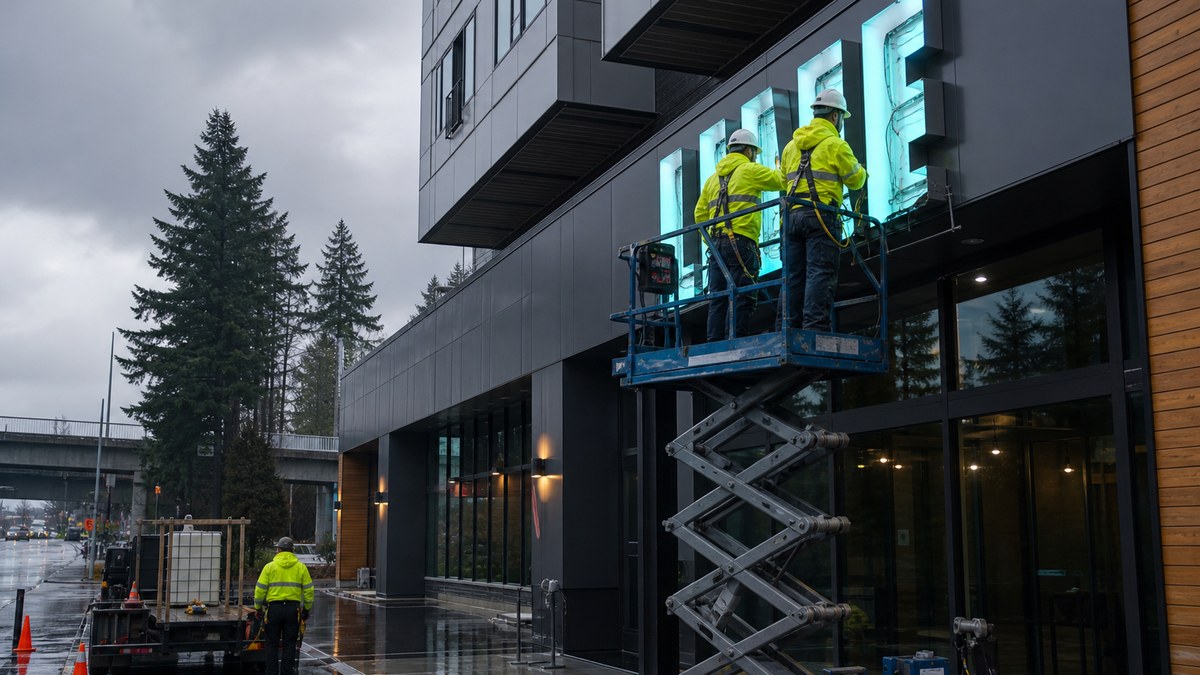
For most storefronts, LED channel letters are the best use of that allowance. They read clearly at night, look premium in the rain, and can be front-lit, halo-lit, or a combination. If you are deciding between styles, our halo-lit vs front-lit channel letters comparison breaks down the look and readability of each. Tenants who need an easier-to-swap panel can use lighted box signs, though letters usually win on looks; see channel letter vs box signs.
Freestanding, monument, and pylon signs
Freestanding signs are generally limited to one per site, or one per 300 feet of arterial street frontage. Total freestanding area is 1 square foot per linear foot of arterial frontage, and freeway frontage does not count. The sign must sit on an arterial frontage when the site has one, and it may not extend into the right-of-way.
Maximum height includes the structure: 25 feet in the CE group of zones (including CE, CM3, EG, EX, IG, IH), 20 feet in CI2, CM2, and CX, and 15 feet in CM1 and RX. That makes Portland better suited to monument signs and mid-height pylon signs than to the tall highway pylons common in Texas. Plan districts can tighten this further. Columbia South Shore, for example, limits monument signs to 6 feet tall and 10 feet long, one per street frontage.
Projecting and blade signs
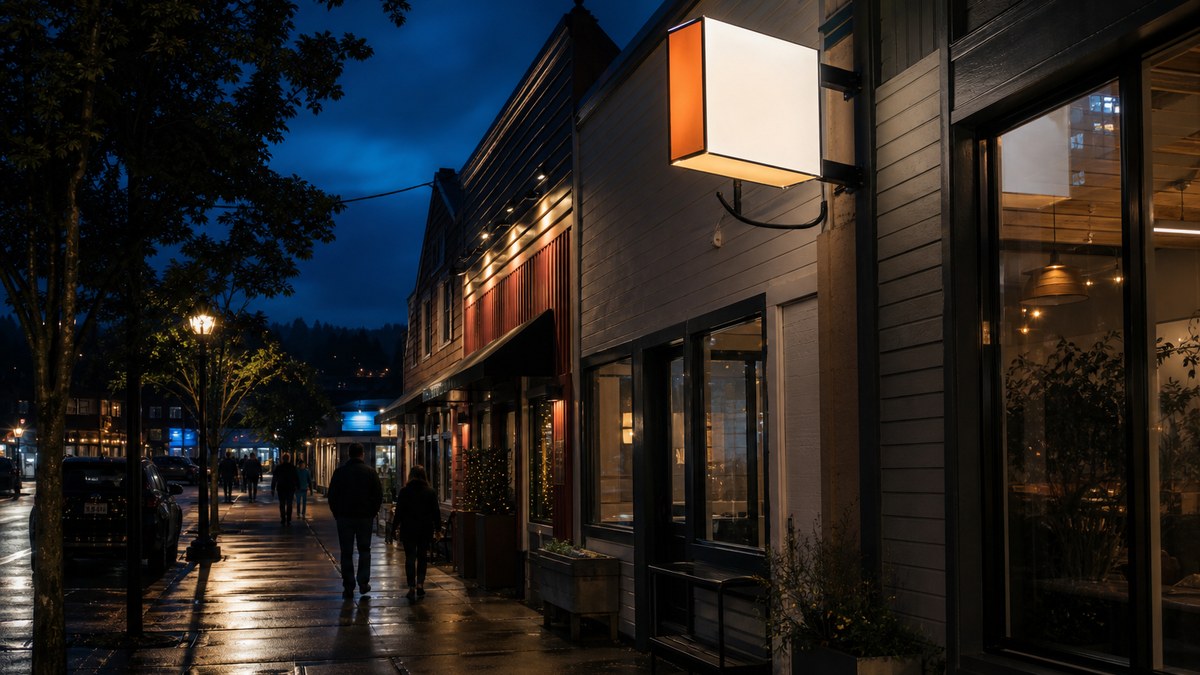
Projecting signs are a classic look in Portland's older commercial districts. A sign projecting over the public right-of-way may extend up to 6½ feet, or two-thirds of the distance to the roadway, whichever is less, and never within 2 feet of the roadway. No more than 30 square feet of sign face may extend over the right-of-way. Signs projecting more than 3 feet must be at least 20 feet apart when they overlap in height.
| Zone group | Max area per sign | Max freestanding height | Digital allowed? |
|---|---|---|---|
| CE, CM3, EG, EX, IG, IH | 200 sq ft | 25 ft | Yes, 20 sq ft per site |
| CI2, CM2, CX | 100 sq ft | 20 ft | Yes, 20 sq ft per site |
| CM1, RX | 50 sq ft | 15 ft | No (sports fields only) |
Portland measures your wall allowance from the primary building wall, not the whole building. On a corner lot, confirm which wall the city treats as primary before you size your letters, because that number drives everything else.
Overlays, plan districts, and historic review
Base zones are only the first layer. Portland has design overlays, historic and conservation districts, individually listed historic resources, and plan districts with their own sign rules. Any of these can add review time or change what is allowed.
- Historic districts and landmarks: signs on historic resources may need historic resource review. Districts such as Skidmore/Old Town and other designated areas favor signs that respect the building's masonry, windows, and proportions. Halo-lit letters, externally lit signs, and well-scaled blade signs tend to fare better than large internally lit cabinets.
- Design overlays: sites in a design overlay, including much of the Central City, may need design review before a sign permit is issued.
- Plan districts: Central City, Columbia South Shore, Hillsdale, Macadam, South Auditorium, Hollywood, and others have extra rules. South Auditorium bans projecting signs. Hollywood bans freestanding signs for new development on enhanced pedestrian streets.
- Prior land use decisions: if your property has an approved adjustment, design review, or historic review, your sign must match that decision exactly.
The city offers short appointments with a planner for properties in design overlays or historic districts. Booking one before final design can save weeks. Our Washington DC sign guide and Philadelphia sign permits guide show how historic review shapes sign design in other older cities, and many of the same design moves work in Portland.
Code-checked signs for every Portland zone
We check your zone, overlays, and digital allowance before design, prepare the drawings and Oregon-engineered calculations, and manage the sign and electrical permits through installation. UL-listed components and multi-year warranties.
The Portland sign permit process, step by step
Portland sign permits are handled by Portland Permitting & Development (the city's permitting bureau) and submitted online through Development Hub PDX. A permit is required for permanent signs on private property, regardless of what the sign says. Changing an existing sign also needs a permit, including switching it from non-illuminated to illuminated, changing its size, or moving it.
1. Prepare the drawings
The city wants one application per sign. Each package typically includes:
- Site plan: address, property lines, buildings, public entrances, vision clearance areas, and every existing and proposed sign.
- Elevations: which way the facade faces, height from grade to the bottom of the sign, distance to the roofline, and any projection over the right-of-way.
- Sign details: dimensions, attachment method, materials, and electrical components.
- Sign area math: primary wall length, the allowable area, and existing, proposed, and total sign area.
- Engineering: structural calculations and details by an Oregon-licensed engineer for freestanding, channel letter, canopy, projecting, and other non-flush signs.
- Digital details: electrical details and measurements of the changing-image area for any digital sign.
Plans are scanned in black and white, so the city asks for clean line drawings, not photos, color renderings, or map screenshots.
2. Submit and pay intake
Applications go in through Development Hub PDX and are reviewed in the order received. Missing items show up as a checklist in the portal, and an incomplete package simply waits.
3. Zoning and structural review
Permit staff check the sign against Title 32. Structural engineers review the drawings under the Oregon Structural Specialty Code; the 2025 edition, based on the 2024 International Building Code, is now in effect. Signs must resist code-required wind, snow, and seismic loads. Only signs that are painted, adhered, or flush-mounted with no air or water access behind them skip structural review.
4. Land use review, if needed
If the sign needs historic review, design review, or an adjustment, that review runs before the permit can issue and can add weeks or months.
5. Electrical permit and inspections
Internally illuminated signs need a separate electrical permit. After issuance, Portland's sign inspections typically include footings (before the pour on freestanding signs), electrical service to the sign, the sign structure (after wall anchors go in, before a fascia or projecting sign is attached), and a final inspection. Complex signs can also need special inspection by a city-certified testing agency.
How long does all of this take? A complete, code-compliant package for a wall sign in a standard commercial zone moves fastest. Freestanding signs, signs needing land use review, and anything in a historic district take longer. A planning window of 4 to 8 weeks for a standard permit is reasonable, with historic or design review adding more. Our sign permit timelines by state guide shows how Portland compares with other markets.
Portland checks electrical licensing up front: the sign permit application must be signed by the electrician doing the work or by the property owner. Line up your licensed sign electrician before you submit, not after the permit is approved.
Licensing: who can wire and install your sign
Oregon licenses sign electrical work at the state level. A limited sign contractor must employ at least one full-time limited journeyman sign electrician, and sign electrical work must be done by appropriately licensed electricians. Wiring follows the Oregon Electrical Specialty Code, which is based on the National Electrical Code, including Article 600 for electric signs. Signs themselves should carry a UL listing, and that is what inspectors expect to see on the label.
This matters because unlicensed sign electrical work can fail inspection, void insurance coverage, and leave you with a sign the city will not sign off. Ask any sign company for its Oregon license numbers and confirm them in the state's license directory before you sign a contract.
Building for Portland's rain, ice, wind, and earthquakes
Portland's climate is mild on paper, but it is hard on signs in specific ways. A sign built for Phoenix or Dallas will not last as long here without a few changes.
Rain and constant moisture
Portland sees roughly three feet of rain in a typical year, most of it from October through May. Water is the top enemy of LED signs. Every channel letter needs working weep holes, sealed seams, and sealed wire entries with drip loops. Power supplies should be UL-listed for wet locations and mounted where they stay dry and can be reached for service. Stainless or coated hardware prevents rust streaks on light-colored facades.
Ice storms and east winds
Winter brings ice storms driven by cold east winds pouring out of the Columbia River Gorge. During the January 2024 storm, gusts topped 50 mph in Portland and reached about 80 mph in the Gorge, and some areas saw close to 1.5 inches of ice. Ice adds weight to faces and cabinets, and wind on an iced-up sign increases the load. Impact-resistant faces, solid cabinet framing, and engineering that accounts for snow and ice loads all pay off.
Seismic design
Portland sits in a region shaped by the Cascadia Subduction Zone, and Oregon's structural code requires signs to resist seismic loads. For freestanding signs, that means engineered foundations and connections, and for wall signs it means properly designed anchors into the structure, not just the cladding. Our pylon sign foundation engineering guide explains how engineers size footings for wind, soil, and seismic loads.
Dark winter evenings
Portland's winter days are short, so your sign is lit for much of the business day from November through February. That favors long-life LED modules, quality drivers, and a maintenance plan. See our commercial LED sign maintenance guide for a practical inspection schedule.
| Portland condition | What it does to signs | What to specify |
|---|---|---|
| Long rainy season | Water in letters, corroded splices | Weep holes, sealed seams, drip loops |
| Ice storms | Added weight, cracked faces | Impact-resistant faces, engineered cabinets |
| Gorge east winds | Higher loads on freestanding signs | Site-specific wind engineering |
| Seismic zone | Stress on anchors and footings | Oregon-engineered connections |
| Short winter days | Many more lit hours | 50,000–100,000 hr LEDs, UL-listed drivers |
Choosing the right sign mix for a Portland site
Because digital area is capped, the best Portland sign packages combine one strong static sign with a small, purposeful digital element. Here is how that plays out for common business types.
Retail storefronts and restaurants
Use the wall allowance on illuminated channel letters, then add a projecting blade sign if the street has foot traffic. Skip the digital display unless you need it for daily specials, and keep it small. A halo-lit logo on brick reads beautifully on a wet evening.
Gas stations, pharmacies, and quick-service brands
A monument or mid-height pylon with a compact LED price or message panel is the classic setup. Design the digital area to fit inside the 10-square-foot-per-sign and 20-square-foot-per-site limits from the start, and confirm the zone allows changing images at all.
Schools, churches, and community buildings
Many of these sit in residential zones, where digital features are prohibited. A well-lit monument sign with changeable static panels, or indirect lighting, is often the only path. Check your zone before you budget for a message center.
Office parks and industrial sites
Employment and industrial zones allow larger signs, up to 200 square feet per sign in EG, EX, IG, and IH, and freestanding signs up to 25 feet. Building-mounted letters and a site monument usually beat a tall pylon for visibility and cost of ownership. Our true cost of LED sign ownership article covers the long-term cost drivers.
Multi-location brands
National brands with a standard LED message center on every pylon need a Portland-specific version. Build it into your rollout plan early; our multi-location brand rollouts guide explains how to handle markets with stricter rules.
Beyond city limits: Portland-area suburbs and Vancouver, WA
Title 32 applies only inside the City of Portland. Each suburb writes its own sign code, and the rules for digital signs can be very different a few miles away.
- Gresham, Beaverton, Hillsboro, Tigard, Lake Oswego, and other suburbs: each has its own sign code, permit counter, and digital sign rules. See our Gresham LED signs and Beaverton LED signs pages.
- Unincorporated areas: county rules apply, and state highway frontage can bring Oregon Department of Transportation review.
- Salem and the Willamette Valley: another set of local codes; see Salem LED signs.
- Vancouver, WA: across the river, Washington's codes and electrical licensing apply instead of Oregon's. See Vancouver LED signs, and our Seattle LED signs page for the rest of Washington.
If you operate locations on both sides of the river, plan for two permit tracks, two sets of drawings, and different licensed electricians. Our locations page lists every metro we serve.
What drives the cost of a Portland sign project
Every Portland project is quoted individually, because the biggest cost factors are site-specific:
- Sign type and size: channel letters, monument, pylon, blade, or cabinet, and how much of your allowance you use.
- Illumination: front-lit, halo-lit, or external lighting, plus any LED message center and its pixel pitch.
- Engineering: Oregon-stamped calculations, footing design, and seismic detailing.
- Reviews: design review, historic review, or an adjustment adds time and drawing work.
- Electrical: a new circuit, distance to the panel, and the separate electrical permit.
- Site access: lifts or cranes, sidewalk closures, and right-of-way permits for blade signs.
The fastest way to an accurate number is to share your address, photos of the building, and the sign you have in mind. We will check the zone and overlays first, so the design you approve is one Portland can permit. You can also browse finished work in our gallery or see all sign services.
The bottom line
Digital signs in Portland are possible, but small. Most commercial and employment zones allow up to 20 square feet of changing-image area per site, and several zones allow none. Smart Portland businesses get their visibility from well-designed static signs, including channel letters, halo-lit logos, blade signs, and monuments, and add a compact LED display only where it adds real value.
Start with your zone, check for overlays and historic status, design inside the Title 32 numbers, and submit a complete package with Oregon-engineered calculations and a licensed sign electrician lined up. Do that, and your Portland sign moves through review with fewer surprises and lasts through many wet winters. If your existing sign needs work first, our sign repair and maintenance team can help, and our channel letter installation guide shows what happens from design to lights-on.
Frequently Asked Questions
Are digital signs allowed in Portland, Oregon?
Yes, in many zones. Portland's sign code, Title 32, allows changing image (digital) sign features in the CE, CI2, CM2, CM3, CX, EG, EX, IG, and IH zones. They are prohibited in residential and open-space zones and in the CM1, CI1, and RX zones, except for signs at sports fields. Some plan districts, such as Macadam, ban them entirely.
How big can an LED message center be in Portland?
Changing image features are limited to 20 square feet in total per site. No single sign may have more than 10 square feet of changing image area unless the digital portion covers less than 60 percent of that sign's face. Adjustments to these limits are generally not allowed outside the Broadway bright lights district, Major Event Entertainment uses, and sports fields.
Do I need a permit for a business sign in Portland?
Yes. Permanent signs on private property need a sign permit from Portland Permitting and Development, regardless of the sign's content. Changing an existing sign, such as adding illumination, changing its size, or moving it, also needs a permit. Internally illuminated signs need a separate electrical permit.
How much wall sign area does Portland allow?
In commercial, employment, and industrial zones, you get 1.5 square feet of sign area per linear foot of primary building wall, or 1 square foot per foot if the same frontage has a freestanding sign. Each sign is also capped at 200, 100, or 50 square feet depending on the zone.
How tall can a monument or pylon sign be in Portland?
Freestanding signs, including the structure, can be up to 25 feet tall in the CE group of zones, 20 feet in CI2, CM2, and CX, and 15 feet in CM1 and RX. Some plan districts set lower limits, such as 6-foot monument signs in Columbia South Shore. Freestanding signs must sit on arterial street frontage when available.
Does a sign in Portland need engineered drawings?
Most do. Freestanding, channel letter, canopy, projecting, and other non-flush signs need structural calculations and details by an Oregon-licensed engineer. The city reviews them under the Oregon Structural Specialty Code for wind, snow, and seismic loads. Only painted, adhered, or flush-mounted signs with no air or water access behind them skip structural review.
How long does a Portland sign permit take?
It depends on the sign and the site. A complete package for a wall sign in a standard commercial zone moves fastest. Planning for about 4 to 8 weeks for a standard permit is reasonable. Historic resource review, design review, or an adjustment can add weeks or months, and incomplete applications wait until the missing items are supplied.
Who can install the electrical part of a sign in Oregon?
Sign electrical work in Oregon must be done by state-licensed electricians. A limited sign contractor must employ at least one full-time limited journeyman sign electrician. In Portland, the sign permit application must be signed by the electrician doing the work or by the property owner.
Can I put a digital sign near a Portland freeway?
Generally no. Changing image signs and freestanding signs that face and sit within 100 feet of a freeway right-of-way are prohibited unless they are below the roadway surface. Similar limits apply near listed Willamette River, Columbia River, and Columbia Slough bridges.
Do Portland suburbs follow the same sign rules?
No. Title 32 applies only inside the City of Portland. Gresham, Beaverton, Hillsboro, Tigard, Lake Oswego, and other cities each have their own sign codes and permit offices, and Vancouver, Washington follows Washington state codes and electrical licensing.
Get a sign Portland will approve and you will love
Tell us your address and what you want to build. We check Title 32, overlays, and digital limits first, then design, engineer, permit, fabricate, and install with UL-listed components and multi-year warranties.
American LED Signage is part of a network of commercial lighting and signage specialists. For projects beyond signage, see our partner sites: Dallas commercial LED, Fort Worth LED lighting, Arlington LED specialists, Plano commercial LED, Irving LED installations, statewide Texas LED lighting, wholesale LED components, American Starlight Ceilings for premium interior fiber optic ceilings, fiber optic lighting systems, modular building solutions, and modular structures in Dallas.