LED Signs in Lowell, MA & Southern New Hampshire: Pylon Signs, Message Boards & Permit Guide
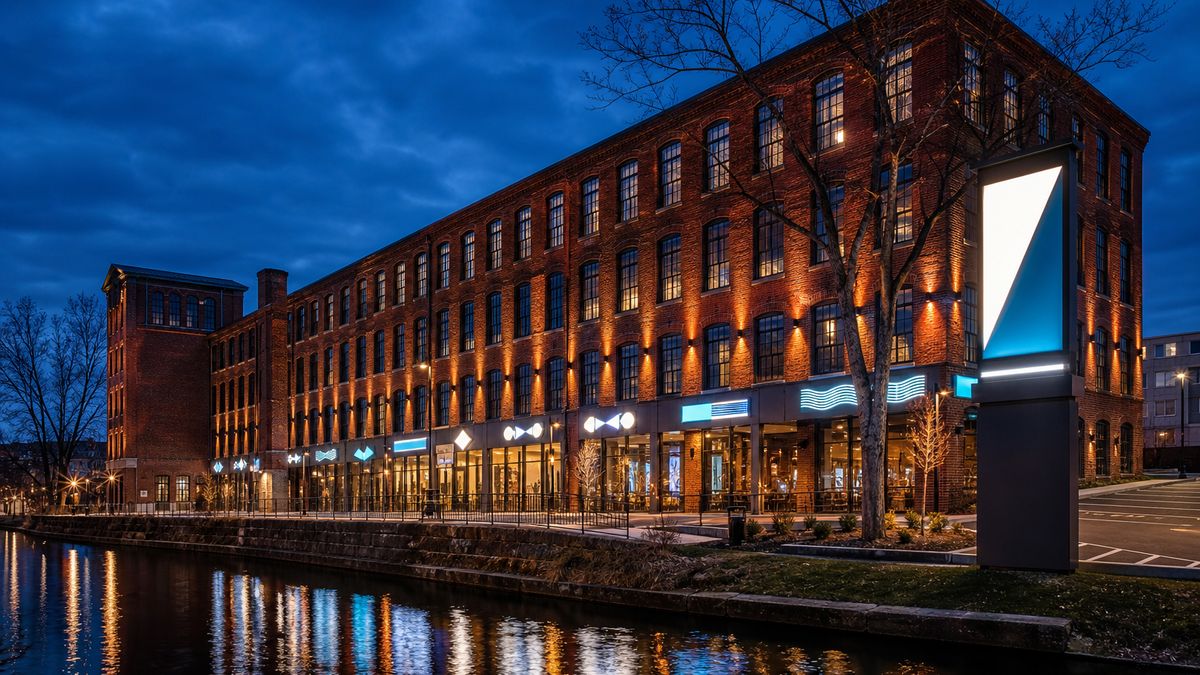
Planning LED signs in Lowell, MA or just over the border in Nashua, Manchester, Merrimack, Londonderry or Derry? You are working in one of the most rule-dense sign markets in New England. Two states, a dozen local codes, a powerful historic board in downtown Lowell, and a winter that punishes cheap parts. The good news: once you know who approves what, a pylon sign, a set of channel letters or an LED message center can move from design to lights-on without surprises.
This guide covers the Merrimack Valley corridor along Route 3 and I-93: Lowell, Haverhill and Peabody on the Massachusetts side, and Nashua, Manchester and their neighbors in southern New Hampshire. It explains the permit path in each place, where electronic message boards are allowed (and where they are not), what the Lowell Historic Board expects downtown, how interior lobby and directory signs fit in, and how to build a sign that survives four New England winters in a row. If your project is elsewhere in Massachusetts, our Massachusetts channel letter guide covers the statewide picture.
LED signs in Lowell, MA and southern New Hampshire need a local sign permit, a building permit for structural signs, and electrical work by a licensed electrician. The local layer is what changes project to project:
- Lowell zoning: Section 6.3 of the Zoning Ordinance governs signs; signs that need relief go through a special permit with abutter notice within 300 feet
- Lowell prohibits: flashing, rotating or motorized moving signs visible from a public street (Sec. 6.3.5)
- Downtown Lowell: every new sign, and any change in message or colors, needs a Lowell Historic Board permit; lit or electronic “open” signs are banned in windows
- Nashua: electronic message centers count as animated signs and need a Zoning Board of Adjustment special exception (since 2023)
- Manchester: the sign permit form lists “Electronic Message Board” as its own type; large signs need structural certification by a NH-registered engineer
- State codes: NH uses the 2021 IBC and 2020 NEC with NH amendments (effective July 1, 2024); Massachusetts uses 780 CMR, 10th Edition
- Climate specs: footings below a roughly 4-foot frost line, cold-start UL-listed power supplies, sealed seams and salt-resistant hardware
Why Lowell and southern NH are one sign market
Lowell sits about four miles from the New Hampshire line. A retailer on Route 3 in Chelmsford, a medical office in Nashua and a franchise pad in Londonderry draw from the same drivers, the same contractors and the same weather. Many businesses run locations on both sides of the border, which is exactly where sign projects get complicated: the same sign that sails through in one town needs a variance in the next.
Here is the practical difference. Massachusetts cities and towns regulate signs through local zoning ordinances and bylaws, with the state building code (780 CMR) and the Massachusetts Electrical Code on top. New Hampshire is similar in structure but different in detail: each city's zoning ordinance controls sign type, size and illumination, the state building code covers structure, and the NEC (with NH amendments) covers wiring. Neither state has a single statewide sign code for on-premise business signs. Your sign company has to read each local code, not just the state one.
| Jurisdiction | Sign rules live in | Electronic message boards | Extra review |
|---|---|---|---|
| Lowell, MA | Zoning Ordinance Sec. 6.3 (Signs) + 6.4 (Illumination) | No flashing/moving | Lowell Historic Board in 11 districts |
| Nashua, NH | Land Use Code Ch. 190, §§ 190-96 to 190-110 | ZBA special exception | Historic (H) Overlay submittals |
| Manchester, NH | Zoning Ordinance sign article | Own permit type | Historic district + Arena Overlay |
| Haverhill / Peabody, MA | Each city's zoning ordinance | Varies by district | Local historic commissions |
| Merrimack / Londonderry / Derry, NH | Each town's zoning ordinance | Varies by town | Planning board site plan |
Lowell, MA sign permits: how the process works
Lowell regulates signs in Section 6.3 of its Zoning Ordinance, with subsections running from applicability through a Table of Sign Regulations (6.3.4), prohibited signs (6.3.5) and nonconforming signs (6.3.10). Illumination has its own section (6.4). Permit applications run through the Division of Development Services at City Hall, 375 Merrimack Street.
When a Lowell sign needs a special permit
Signs that fit the sign table are handled as a standard sign and building permit. Signs that need relief from the table go through a special permit, and Lowell's Sign Permit Supplement spells out what that package needs:
- Original elevation and sign plans, with at least one architectural rendering showing the sign as seen from the public way
- A written narrative addressing the special permit criteria in Section 11.2.3
- A certified abutters list for properties within 300 feet, obtained from the City Assessor
- Proof of your relationship to the property (deed, purchase and sale agreement or lease) and the owner's signed authorization
- Plans in PDF, plus photo evidence that the “Request for Permit” notice sign has been posted on site
The Board of Appeals is the default special permit granting authority in Lowell. Once granted, a special permit lapses if work has not started within 24 months (Section 11.3.8), so do not let an approval sit on a shelf while a lease is negotiated.
What Lowell prohibits
Section 6.3.5 lists prohibited signs. The ones that matter most for LED projects:
- Signs that flash, rotate or have a motorized moving part visible from a public street
- Signs the Building Commissioner considers a traffic hazard
- String lights used for commercial purposes (holiday decorations excepted)
- Signs attached to fences, utility poles, trees or rocks
The ordinance defines a flashing sign as an illuminated sign whose light is not held at a stationary or constant intensity. That definition is why any LED message center proposed in Lowell needs to be programmed with static messages, smooth transitions and automatic dimming rather than chase, scroll or video effects. Talk to the city before you order a full-color board, and design the controller settings into the permit drawings.
Sign area in Lowell counts the lettering, designs and background, but not the supporting framework. Individual channel letters are measured by the smallest rectangle or shape that encloses them. Tight letter spacing and a slim raceway can buy you visible letter height inside the same allowed square footage.
Downtown Lowell: the Lowell Historic Board
The Lowell Historic Board (LHB) has design review, permitting and enforcement authority in 11 districts: the Downtown Lowell Historic District, created in 1983, plus ten neighborhood districts including the Acre, Andover Street, Belvidere Hill, South Common, Washington Square and Wannalancit Street. Inside the downtown district, any exterior change needs LHB approval before other city permits, and the board's design standards say every new sign, and every change in an existing sign's message or colors, visible from a street, sidewalk, alley or canal, needs a Historic Permit.
The downtown design standards in plain English
- External lighting is preferred. Any illumination must be non-flashing, glare-free and non-moving.
- Internal lighting is limited to contemporary buildings and specific forms: back-lit individual letters against a softly lit wall, letters with translucent faces lit from inside, or metal-faced cabinets with dark opaque backgrounds and cut-out letters. A plain plastic lightbox is not on the list.
- Neon is allowed only in exceptional, custom-designed cases.
- Projecting signs are capped at 9 square feet on the first floor and reserved for ground-floor tenants (with lobby exceptions). Bracket screws go into mortar joints, not brick faces.
- Placement: the first sign belongs in the storefront sign band; wall signs generally stay below the second-story window sills.
- Design: lettering should fill no more than about 60% of the sign; light letters on a dark background are the norm; metal and wood are strongly encouraged.
- Windows: electronic, illuminated and neon “open” signs are prohibited in the district. The LHB provides approved open/closed signs to downtown businesses.
Where the LHB standards and the city sign code disagree, the stricter rule applies. Minor items, such as placing or removing an approved sign type, can be handled by staff. Major changes go to a public hearing; the board meets on the second Monday of the month at 6:00 p.m., with submittals due roughly four weeks ahead. A Historic Permit is valid for one year. The standards date from 2012, so confirm current wording with LHB staff before you finalize a design.
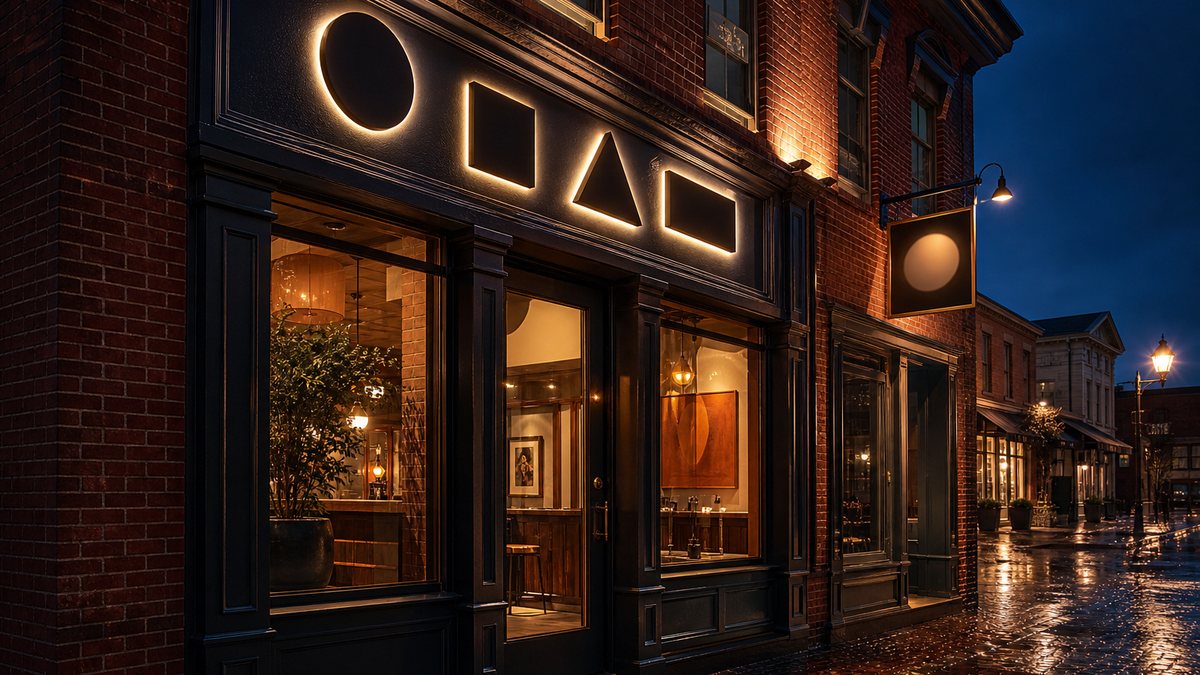
For historic storefronts, that usually means halo-lit metal letters (confirm with staff, since halo lighting is not named in the standards), externally lit painted or carved signs, or a modest projecting sign. Our comparison of halo-lit vs front-lit channel letters walks through how each looks on brick. Downtown small businesses may also qualify for the LHB sign grant, which reimburses approved sign design, fabrication and installation after inspection. The design must be approved and the Historic Permit issued before anything is fabricated.
Nashua, NH: electronic signs by special exception
Nashua regulates signs in Chapter 190 of its Land Use Code, with the operative sign rules in §§ 190-96 through 190-110 and submittal rules in § 190-278. Two definitions drive LED projects. An electronic message center is a sign electronically controlled to show different copy on the same face. An animated sign includes electronic message centers. In practice, that means a digital board in Nashua is treated more strictly than a static lit sign.
In 2023 the city amended its ordinance to allow electronic signage with a special exception from the Zoning Board of Adjustment (ZBA). To grant one, the ZBA has to find the sign will not impair the integrity of, or be out of character with, the district or neighborhood. A late-2024 proposal to add by-right standards for government signs (a five-second minimum hold, adjustable brightness, no video, and a cap on message area) was postponed indefinitely by an aldermanic committee in November 2024, so expect the special exception path for a private business board.
What a Nashua sign application needs
- A completed application, a photo of existing signage, and a sketch showing area, height, setback and location
- Materials, colors, illumination, animation and function of the sign
- In a Historic (H) Overlay District: scale drawings, enlarged photos, color/lettering/material/illumination samples, and a total signage concept for multitenant buildings
Nashua measures sign height from the adjacent undisturbed grade to the top of the sign, so a berm built up under a monument sign does not earn extra height. Every sign must also carry a label with the fabricator or installer's name and its electrical rating in volts and amps. Nashua's Part 8 definitions were amended again in December 2025, so check the current text before filing.
Manchester, NH: message boards and the Arena Overlay
Manchester's sign permits run through the Building Regulations Division of Planning & Community Development at One City Hall Plaza. The application asks up front whether the property is in a historic district or the Arena Overlay District around downtown, and it lists “Electronic Message Board” as its own sign type next to wall, window, roof, freestanding and projecting signs.
The application package must include plans and elevations drawn to scale showing the sign, its exact location to its outer edge, the methods of attachment, structural support and illumination, and a master inventory of all existing signs on the property. Large signs require structural certification by a New Hampshire registered engineer.
Downtown, digital signs get real scrutiny. In July 2025, a proposal for a 576-square-foot electronic message center on a new mixed-use building at 516 Elm Street drew a recommendation for denial from the Arena Overlay design review committee, which cited the district's character and light trespass on nearby residences. The lesson for any Manchester business: a modest, auto-dimming board with static messages, sited away from homes, has a far better chance than a large video wall.
New Hampshire's State Building Code is the 2021 IBC and the 2020 NEC, each with NH amendments, effective July 1, 2024 under HB 1059-2024. Massachusetts uses 780 CMR, 10th Edition (based on the 2021 IBC), and the Massachusetts Electrical Code (527 CMR 12.00). Your engineer and electrician design to whichever state the sign stands in, even if the business is headquartered across the line.
The suburbs: Merrimack, Londonderry, Derry, Haverhill, Peabody
The towns between the cities write their own sign rules, and they often differ more from each other than from Lowell or Nashua. On the Massachusetts side, Haverhill and Peabody each have their own zoning ordinances and historic commissions. In New Hampshire, Merrimack, Londonderry and Derry regulate freestanding sign height, sign area and electronic changeable copy through their zoning ordinances, and new commercial sites usually go through planning board site plan review where the sign package is reviewed with the building.
Three habits keep suburban projects moving:
- Confirm the jurisdiction by parcel. Route 3, Route 102 and the Daniel Webster Highway cross town lines repeatedly. The mailing address is not always the permitting town.
- Ask about electronic copy before design. Some towns allow message centers by right in commercial districts, some by special exception, and some only as a small portion of a ground sign.
- Bundle the sign with the site plan. If you are building new, put the sign on the site plan from the start. Adding a pylon later can mean a second round of review.
See our city pages for Lowell, Nashua and Manchester for local service details.
Pylon and pole signs: engineering for New England
Tall freestanding signs along Route 3, I-93, Route 101 and the Lowell Connector have to handle three things: wind, frost and plows. Pylons and pole signs need engineer-sealed structural drawings in most jurisdictions here, and Manchester's form says so outright for large signs.
Wind
ASCE 7 basic wind speeds for typical commercial signs (Risk Category II) in the inland Merrimack Valley fall in roughly the 115–120 mph range, rising toward the coast. Highway frontage is usually designed as open terrain (Exposure C), which raises the load. Your engineer pulls the exact value for the site.
Frost
Footings in this region typically go below a frost depth of about 4 feet, and drilled piers for pylons go much deeper based on overturning loads and the soil report. Glacial till, ledge and boulders are common in southern New Hampshire, so a geotechnical report and an experienced drilling crew save time. Our pylon sign foundation guide explains how piers are sized.
Snow and plows
Monument and low pylon signs near parking lots take hits from plows and snowbanks. Set signs back from plow paths, add bollards where needed, and specify impact-resistant faces. Ground-level message centers should sit high enough that a winter snowbank does not bury the bottom rows.
LED message centers: getting a digital board approved
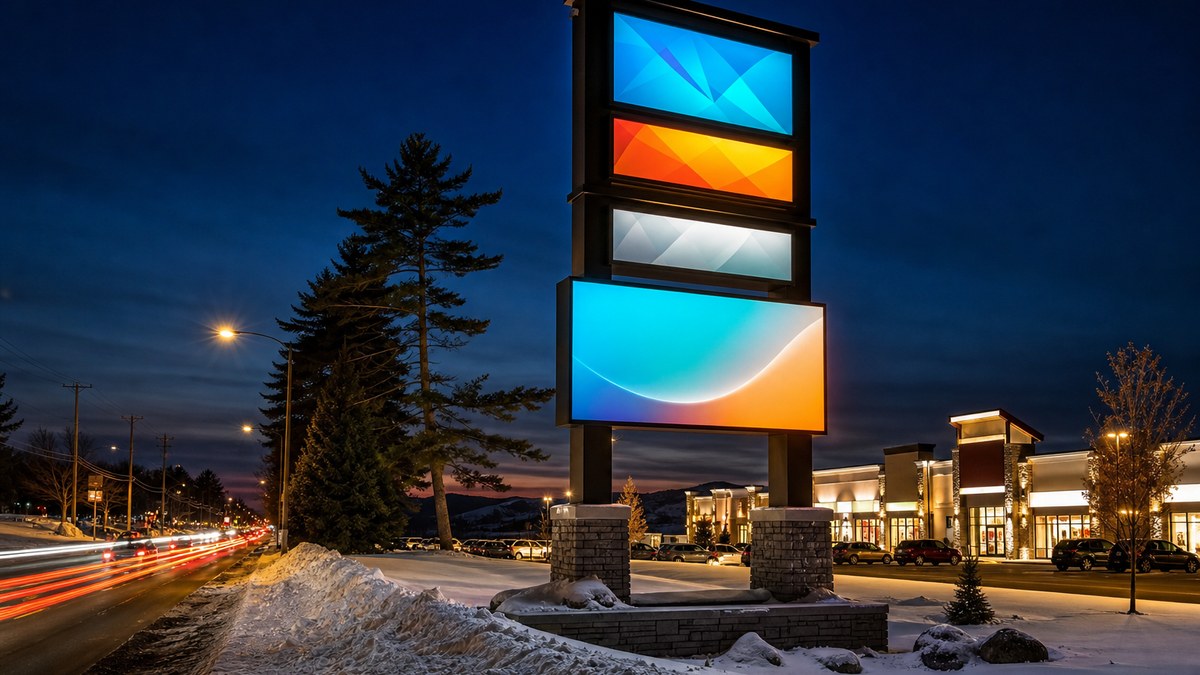
Search data for this region shows a lot of interest in “electronic message boards” in Lowell, Nashua and Manchester. Here is what gives a digital sign its best shot at approval in a cautious market:
- Static messages only. No flashing, chasing, scrolling or video. Lowell prohibits flashing and moving signs; Nashua treats message centers as animated signs.
- Long hold times. Nashua's 2024 draft used a five-second minimum; many New England towns use 8 seconds or more. Program to the strictest rule you face.
- Automatic dimming. A photocell that steps brightness down at night. The common industry benchmark is no more than 0.3 footcandles above ambient light, measured at a set distance.
- Right-sized display. A message area that is a portion of the sign, framed by a static cabinet with your name, reads as a business sign rather than a billboard.
- Pixel pitch for the road. Arterial roads at 35–45 mph usually suit 10–16 mm; a monument at an office park entrance can use a finer pitch. Our programmable LED sign buyer's guide covers pitch, size and brightness.
Billboards are a separate system. Off-premise advertising signs in Massachusetts are regulated by the state Office of Outdoor Advertising, and in New Hampshire by state outdoor advertising law administered with NHDOT, on top of local zoning. Our LED billboards guide explains the federal and state layers.
Signs designed for local codes and New England winters
Pylons, monument signs, channel letters and LED message centers for Lowell, Nashua, Manchester and every town in between. We prepare permit-ready drawings and build with UL-listed components backed by multi-year warranties.
Interior lobby, directory & indoor signs
Not every sign project here is outdoors. Lowell's converted mills, medical buildings and office parks generate steady demand for lobby logos, interior directory signs and wayfinding. Interior signs usually do not need a zoning sign permit, but they do have rules:
- Accessibility. Signs that identify permanent rooms and spaces follow the 2010 ADA Standards (Section 703): raised characters with Grade 2 braille, mounted so the tactile characters sit between 48 and 60 inches above the floor, on the latch side of the door.
- Electrical. Illuminated lobby logos and backlit directories are still electrical signs. They should be UL-listed and wired by a licensed electrician; a building electrical permit is typically required.
- Building rules. Landlords in multi-tenant buildings often set directory formats, letter styles and finishes. Get the landlord's sign criteria before design.
- Modular directories. In buildings with changing tenants, modular directory systems with replaceable inserts avoid reprinting the whole sign every time a suite turns over.
Exterior wall signs and lighted box signs remain zoning items, even on a mill building with a big blank wall. In Lowell's historic districts, mill buildings fall under the LHB too.
Building for New England winters
Lowell and southern New Hampshire see repeated freeze-thaw cycles, nor'easters, ice storms and heavy road salt. Those conditions kill signs slowly: water gets in, freezes, opens seams wider, and corrodes connections. Specify these items on any outdoor sign here:
| Winter threat | What fails | Specify |
|---|---|---|
| Cold starts | Power supplies that struggle below freezing | Cold-start UL-listed drivers |
| Freeze-thaw | Seams, face retainers, wire entries | Sealed seams + weep holes |
| Road salt | Fasteners, anchor bolts, connectors | Stainless or coated hardware |
| Ice and plows | Plastic faces, low cabinets | Impact-resistant faces, setbacks |
| Frost heave | Shallow footings that tilt | Footings below ~4 ft frost |
| Short winter days | Signs that run long hours | 50,000–100,000 hr LEDs + timers |
Inspect every outdoor sign in the fall before the first freeze and again in spring after salt season. Our commercial LED sign maintenance guide lays out a full schedule, and our sign repair and maintenance team handles inspections and fixes. If an older fluorescent or neon sign is failing, read repair vs replace before you commit.
Timeline: from design to lights-on
Every project differs, but these phases are typical for the region. Treat the ranges as planning estimates, not promises.
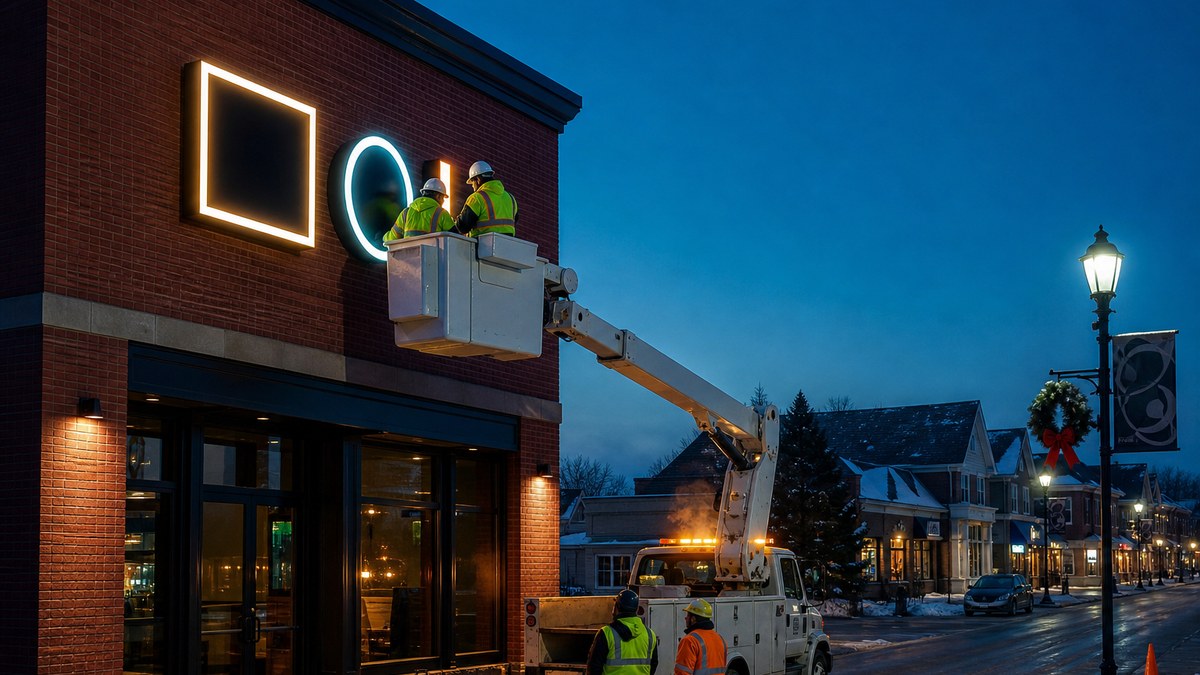
- Site survey and code check (1–2 weeks). Confirm jurisdiction, zoning district, historic or overlay status, existing signs and electrical service.
- Design and landlord approval (1–3 weeks). Drawings with dimensions, illumination details and controller settings for any message center.
- Engineering (1–2 weeks). Stamped structural calculations for pylons, monuments and large wall signs; soil report for tall signs.
- Permits (varies most). A standard sign permit can move in a few weeks. A Lowell special permit, an LHB public hearing or a Nashua ZBA special exception adds hearing notice and meeting cycles, often one to three months. See sign permit timelines by state.
- Fabrication (3–6 weeks). Runs during permitting once the design is locked.
- Installation and inspection (1–3 days on site). Foundations need cure time before a pylon goes up, and frozen ground can pause excavation in deep winter, so start pylon permits in late summer or fall when you can.
For the installation steps themselves, see our channel letter installation guide.
What drives the cost of a sign here
We do not publish prices because they depend on the project and change often. These are the factors that move a quote in this region:
- Sign type, size and height, and whether a message center is included
- Illumination style: halo-lit, front-lit, external lighting or digital
- Engineering, soil testing and foundation depth for freestanding signs
- Permit path: standard permit vs special permit, historic review or ZBA hearing
- Electrical work: new circuits, disconnects and trenching across a parking lot
- Winter-grade components: cold-start drivers, stainless hardware, impact faces
- Site access: bucket truck or crane, traffic control, sidewalk permits downtown
Browse finished work in our gallery, see every sign service we offer, or check all service locations, including Boston, Quincy and Worcester. Then request a free quote.
Frequently Asked Questions
Do I need a permit for an LED sign in Lowell, MA?
Yes. Permanent exterior signs in Lowell are regulated by Section 6.3 of the Zoning Ordinance and need a sign permit, and illuminated signs also need electrical work by a licensed electrician. Signs that do not fit the sign table require a special permit, which includes plans, a narrative, a certified abutters list within 300 feet and proof of your relationship to the property. In historic districts you also need a Lowell Historic Board permit first.
Are electronic message boards allowed in Lowell?
Lowell's Zoning Ordinance prohibits signs that flash, rotate or have moving parts visible from a public street, and defines a flashing sign as one whose light is not held at a constant intensity. Any LED message center proposed in Lowell should run static messages with automatic dimming and no animation, and should be reviewed with the city before ordering. In the Downtown Lowell Historic District, electronic and lit window signs are prohibited.
What does the Lowell Historic Board require for signs?
In the Downtown Lowell Historic District, every new sign and every change to an existing sign's message or colors needs a Historic Permit. The standards prefer external lighting, allow internal lighting only in limited forms on contemporary buildings, cap first-floor projecting signs at 9 square feet, place signs in the storefront sign band, and favor metal and wood with light letters on a dark background. Major changes go to a public hearing on the second Monday of the month.
Can I put an LED message center sign in Nashua, NH?
Possibly. Nashua's Land Use Code treats electronic message centers as animated signs. Since a 2023 amendment, electronic signs can be allowed by special exception from the Zoning Board of Adjustment, which must find the sign will not impair the integrity of or be out of character with the district. A 2024 proposal for by-right standards for government signs was postponed indefinitely, so private businesses should plan for the special exception process.
What does Manchester, NH require for a sign permit?
Manchester's application, filed with the Building Regulations Division of Planning and Community Development, asks for the zoning district and whether the site is in a historic district or the Arena Overlay District. It requires scaled plans and elevations showing the sign location, attachment, structural support and illumination, plus an inventory of existing signs. Large signs require structural certification by a New Hampshire registered engineer. Electronic message boards are a separate sign type on the form.
Which building and electrical codes apply to signs in New Hampshire?
New Hampshire's State Building Code adopts the 2021 International Building Code and the 2020 National Electrical Code, each with New Hampshire amendments, effective July 1, 2024 under HB 1059-2024. Local zoning ordinances control sign size, height, location and illumination. Electrical work on illuminated signs should be done by a New Hampshire licensed electrician with UL-listed sign components.
How deep does a pylon sign foundation go in New England?
Footings in Lowell and southern New Hampshire typically extend below a frost depth of about 4 feet, and drilled piers for pylon signs often go considerably deeper depending on sign height, wind load and soil conditions. A structural engineer sizes the foundation from the site's design wind speed and a soil report. Ledge and glacial boulders are common in southern New Hampshire and can affect drilling.
Do interior lobby and directory signs need a permit?
Interior signs usually do not need a zoning sign permit, but illuminated lobby signs still need a licensed electrician and typically an electrical permit, and room identification signs must meet the 2010 ADA Standards with raised characters and braille mounted 48 to 60 inches above the floor on the latch side of the door. Landlord sign criteria often control directory design in multi-tenant buildings.
How long does it take to get an LED sign installed in Lowell or Nashua?
A straightforward storefront sign with a standard permit often takes several weeks from design to installation. Projects that need a Lowell special permit, a Lowell Historic Board hearing or a Nashua Zoning Board of Adjustment special exception add public notice and meeting cycles, often one to three months. Pylon signs also need engineering and foundation cure time, and frozen ground can delay excavation in winter.
How much does an LED sign cost in Lowell or southern New Hampshire?
Cost depends on sign type and size, illumination style, whether a message center is included, engineering and foundation needs, the permit path, electrical work, winter-grade components and site access. Because these vary so much by project, American LED Signage provides free project-specific quotes. Call (702) 738-2218 or request a quote online.
Not sure what your town allows? We will check it.
Send us your address and the sign you have in mind. We will confirm the jurisdiction, flag historic or overlay review, and come back with a code-ready design and a free quote.
American LED Signage is part of a network of commercial lighting and signage specialists. For projects beyond signage, see our partner sites: Dallas commercial LED, Fort Worth LED lighting, Arlington LED specialists, Plano commercial LED, Irving LED installations, statewide Texas LED lighting, wholesale LED components, American Starlight Ceilings for premium interior fiber optic ceilings, fiber optic lighting systems, modular building solutions, and modular structures in Dallas.